Showing posts with label brigitte bardot. Show all posts
Saturday, November 28, 2020
Lies and sexy ladies: Two clickbait staples
Posting photos of attractive women online apparently isn’t enough to draw curious web surfers these days. So, clickbait purveyors add lies to their sponsored articles to generate clicks.
What follows are some recent examples I’ve seen.
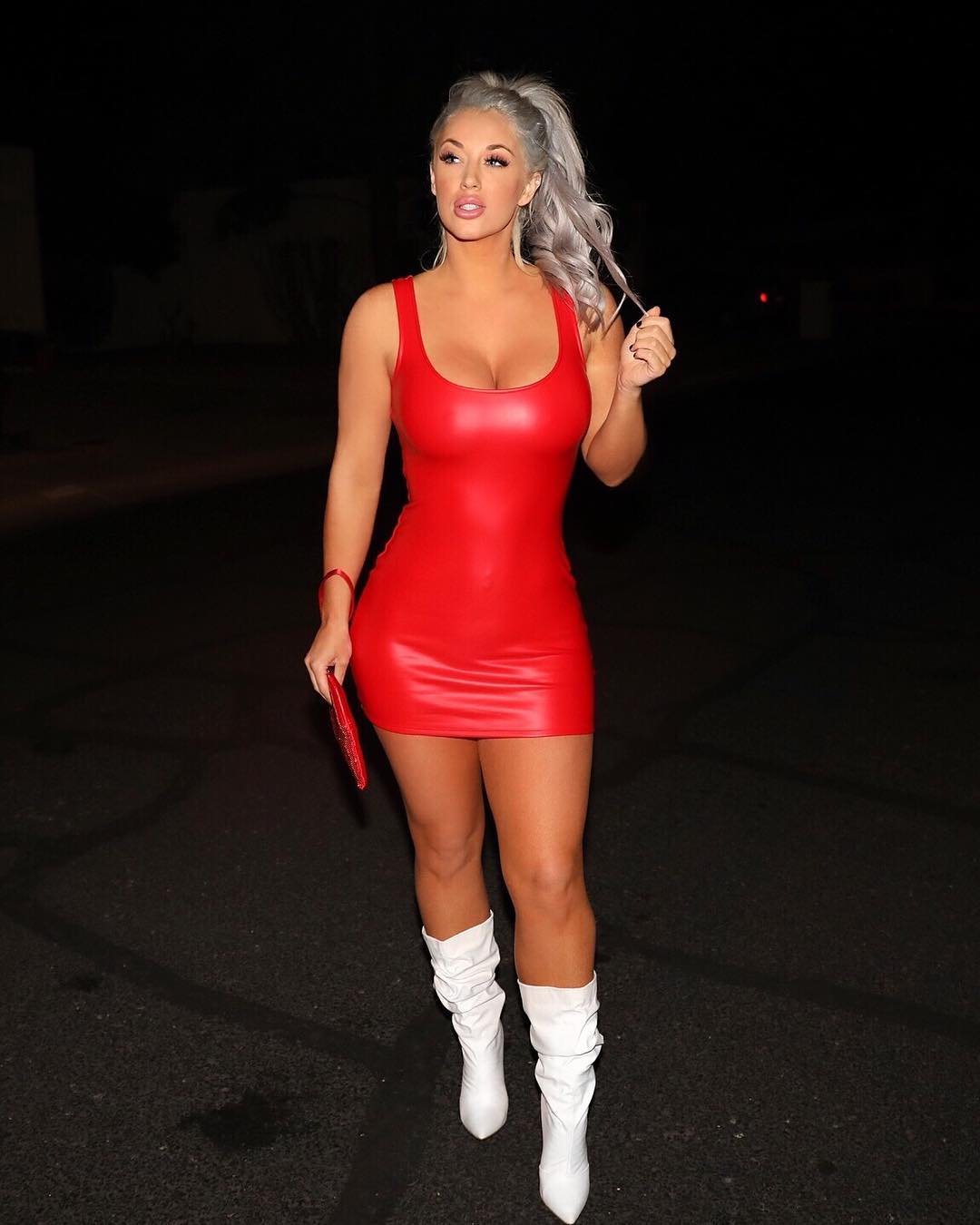
LiveIntent ran an article titled “Tiger Woods’ ex-wife is almost 50 and time has not been kind to her.” First off, his ex-wife, Elin Nordegren, is only 40. Second, the clickbait post used a photo of model Laci Kay Somers. She was the subject of false rumors in 2017 that she was dating Woods. (See articles by CBS Detroit and Sarah Scoop.)
Taboola ran an article titled “This one photo caused her marriage to dissolve immediately.” It used a photo of Instagram model Lillie Artale. The same photo was used for a LiveIntent article titled “Man decides to file for divorce after taking a closer look at this photo.”
Artale told Tech-media-tainment that the clickbait article falsely represented her and that she did not give permission for the use of her image. She also contacted Taboola about the misuse of her image.
Another LiveIntent article titled “Johnny Carson’s daughter doesn’t hold back” used a photo of actress Carol Wayne, who is not his daughter.
Finally, Smartfeed ran an article titled “Rare photos of old Las Vegas show true Sin City.” But the post used a picture of French actress Brigitte Bardot taken in 1953 on the beach at the Cannes Film Festival.
Saturday, September 30, 2017
Lying clickbait: Fake locations, fake historical photos
Lying clickbait never rests, so neither can I.
Here are the latest examples I’ve seen while surfing the web.
A sponsored article titled “20 places on Earth you’re not allowed to visit ever” could have included a photo from one of many interesting locations. Instead it chose a Photoshopped fake.
The article used a picture where a star-shaped island was added next to Hawaii’s Molokini Crater reef. The result is an island formation that looks like the star and crescent symbol of Islam.
A Taboola sponsored article promising “actual Wild West photos” uses a modern photo taken by Ed Ross.
Ross, who died last year, used the Collodion process or wet-plates for his final eight years of work. By replicating the early photographic process, Ross created images that looked historical. (See articles by Nerve and Juxtapoz.)
Another article titled “Old love, new life: Finally ties the knot at 68” used a photo of actors Robert Redford and Meryl Streep. They are not married to each other as the headline implies and neither married at 68, for that matter.
The next three examples are variations on lying clickbait that I’ve seen for some time.
A Revcontent sponsored article titled “25 final photos taken before tragedy struck” used another picture from Brazil’s Pedra do Telegrafo. The rock cliff is just a few feet off the ground, but photos can make it look like people on it are in danger.
(See earlier examples from posts on July 31 and Sept. 10.)
A Taboola article titled “Historical WW2 photos that are pretty unnerving” used a picture of model Dee Marie taken in 2014 by photographer Mark Goodman. (See earlier examples from posts on Nov. 16, 2016, and March 19.)
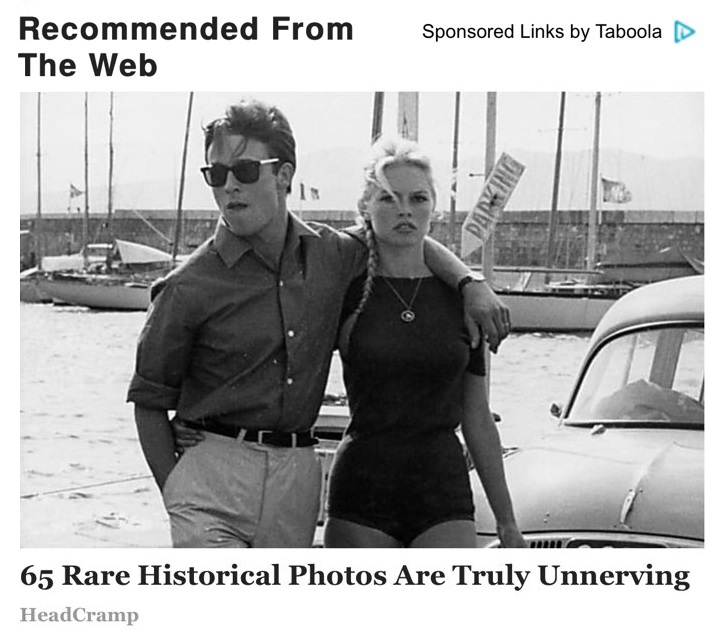
Finally, a Taboola sponsored article titled “65 rare historical photos are truly unnerving” used a photo of actress Brigitte Bardot with Jacques Charrier in Saint Tropez in 1959. The only thing unnerving about Bardot is what an absolute smokehouse she was.
Here are the latest examples I’ve seen while surfing the web.
A sponsored article titled “20 places on Earth you’re not allowed to visit ever” could have included a photo from one of many interesting locations. Instead it chose a Photoshopped fake.
The article used a picture where a star-shaped island was added next to Hawaii’s Molokini Crater reef. The result is an island formation that looks like the star and crescent symbol of Islam.
A Taboola sponsored article promising “actual Wild West photos” uses a modern photo taken by Ed Ross.
Ross, who died last year, used the Collodion process or wet-plates for his final eight years of work. By replicating the early photographic process, Ross created images that looked historical. (See articles by Nerve and Juxtapoz.)
Another article titled “Old love, new life: Finally ties the knot at 68” used a photo of actors Robert Redford and Meryl Streep. They are not married to each other as the headline implies and neither married at 68, for that matter.
The next three examples are variations on lying clickbait that I’ve seen for some time.
A Revcontent sponsored article titled “25 final photos taken before tragedy struck” used another picture from Brazil’s Pedra do Telegrafo. The rock cliff is just a few feet off the ground, but photos can make it look like people on it are in danger.
(See earlier examples from posts on July 31 and Sept. 10.)
A Taboola article titled “Historical WW2 photos that are pretty unnerving” used a picture of model Dee Marie taken in 2014 by photographer Mark Goodman. (See earlier examples from posts on Nov. 16, 2016, and March 19.)
Finally, a Taboola sponsored article titled “65 rare historical photos are truly unnerving” used a photo of actress Brigitte Bardot with Jacques Charrier in Saint Tropez in 1959. The only thing unnerving about Bardot is what an absolute smokehouse she was.
Sunday, May 14, 2017
Brigitte Bardot is definitely suitable for history books
Clickbait purveyors love to use photos of French actress Brigitte Bardot from her prime.
She’s rarely identified by name in the headlines of clickbait articles. It’s a technique designed to exploit the curiosity gap in young men who aren’t familiar with the stunningly beautiful screen star.
Often the headlines say, “Rare photos not suitable for history books.” If my history books had more smoking hot babes like Bardot, I would have paid more attention.
I’ve noted how clickbait promoters like using Bardot pictures in three other articles. (Check out “Lying clickbait: Brigitte Bardot photos were never ‘classified’”, “Lying clickbait: Pretty women as the honeypot” and “Clickbait favorites: Sexy female celebrities for sponsored articles.”)
What follows are some of the latest examples of Bardot as the honeypot for clicks.
She’s rarely identified by name in the headlines of clickbait articles. It’s a technique designed to exploit the curiosity gap in young men who aren’t familiar with the stunningly beautiful screen star.
Often the headlines say, “Rare photos not suitable for history books.” If my history books had more smoking hot babes like Bardot, I would have paid more attention.
I’ve noted how clickbait promoters like using Bardot pictures in three other articles. (Check out “Lying clickbait: Brigitte Bardot photos were never ‘classified’”, “Lying clickbait: Pretty women as the honeypot” and “Clickbait favorites: Sexy female celebrities for sponsored articles.”)
What follows are some of the latest examples of Bardot as the honeypot for clicks.
Wednesday, March 29, 2017
Clickbait favorites: Sexy female celebrities for sponsored articles
Clickbait purveyors often use unknown or little known attractive women to promote their articles. But sometimes they use celebrities past and present.
I’ve previously reported about the fixation content marketing services have with Brigitte Bardot. She was a ridiculously beautiful woman when she was making movies from 1952 to 1973.
Her photos create curiosity among young male web surfers who likely aren’t familiar with the French sex kitten. (See also “Lying clickbait: Brigitte Bardot photos were never ‘classified’” and “Lying clickbait: Pretty women as the honeypot.”)
The same holds for actress Jane Fonda. She was a striking beauty in her youth and millennials are probably unfamiliar with her.
She also was a controversial figure during the Vietnam War for showing support for the enemy of the U.S. She earned the nickname “Hanoi Jane” after visiting the North Vietnamese troops.
Another popular celebrity for clickbait articles is actress Milana Vayntrub, best known for her AT&T commercials, where she plays an AT&T store employee. (See photo at top.)
Other celebrities used in recent clickbait promos have included models Kate Upton and Gigi Hadid.
A photo of Upton was used for a clickbait article titled “The cameraman just kept recording.” It’s a still image from a sexy Easter video that Upton did for Love magazine. (See it here on YouTube.)
The picture of Hadid was used to promote an article titled “Photos from jaw-dropping actresses from the past.” However, Hadid is a model, not an actress, and she’s very much of the present.
Sometimes the celebrities are of the more obscure variety.
A Taboola sponsored article titled “33 eye-popping photos left out of history books” included a photo of Playboy magazine’s 1969 Playmate of the Year, Connie Kreski. Kreski is pictured with a pink Ford Shelby Mustang GT-500 that she received as one of her gifts for winning the title.
I’ve previously reported about the fixation content marketing services have with Brigitte Bardot. She was a ridiculously beautiful woman when she was making movies from 1952 to 1973.
Her photos create curiosity among young male web surfers who likely aren’t familiar with the French sex kitten. (See also “Lying clickbait: Brigitte Bardot photos were never ‘classified’” and “Lying clickbait: Pretty women as the honeypot.”)
The same holds for actress Jane Fonda. She was a striking beauty in her youth and millennials are probably unfamiliar with her.
She also was a controversial figure during the Vietnam War for showing support for the enemy of the U.S. She earned the nickname “Hanoi Jane” after visiting the North Vietnamese troops.
Another popular celebrity for clickbait articles is actress Milana Vayntrub, best known for her AT&T commercials, where she plays an AT&T store employee. (See photo at top.)
Other celebrities used in recent clickbait promos have included models Kate Upton and Gigi Hadid.
A photo of Upton was used for a clickbait article titled “The cameraman just kept recording.” It’s a still image from a sexy Easter video that Upton did for Love magazine. (See it here on YouTube.)
The picture of Hadid was used to promote an article titled “Photos from jaw-dropping actresses from the past.” However, Hadid is a model, not an actress, and she’s very much of the present.
Sometimes the celebrities are of the more obscure variety.
A Taboola sponsored article titled “33 eye-popping photos left out of history books” included a photo of Playboy magazine’s 1969 Playmate of the Year, Connie Kreski. Kreski is pictured with a pink Ford Shelby Mustang GT-500 that she received as one of her gifts for winning the title.
Sunday, February 12, 2017
Lying clickbait: Pretty women as the honeypot
I’ve documented many times how online content promotion services like to use photos of pretty women to attract visitors.
Sometimes they use a vaguely misleading headline with a picture of a sexy woman. Other times they misidentify the woman in the photo.
In one recent example on Yahoo, they used a photo of busty English glamour model Keeley Hazell with an article titled “McKayla Maroney looks completely unrecognizable.”
Yeah, she’s unrecognizable because that’s not her.
Here’s what Olympic gymnast Maroney looks like today.
In another example on Yahoo, a content promotion service used a photo of curvaceous Russian model Anastasia Kvitko with an article titled “These Olympians are completely jaw-dropping now.” Kvitko was never an Olympic athlete. (Is motor-boating an Olympic sport?)
A Taboola article titled “Michael Jackson’s daughter is absolutely gorgeous” used a photo of actress Brooke Shields, who is definitely not Jackson’s daughter. It is inexplicable why Taboola didn’t use a photo of Paris Jackson here. She is quite attractive and actually is Jackson’s daughter.
As I’ve noted before, photos of gorgeous French actress Brigitte Bardot are often used to advertise articles unrelated to her. (See “Lying clickbait: Brigitte Bardot photos were never ‘classified.’”)
Here are two more recent examples. Bardot’s image was used to promote Taboola articles titled “Rare photos not suitable for history books” and “Long-lost mobster photos that will make your skin crawl.”
Another Taboola article titled “12 mysterious photos that cannot be explained” used a photo of actress Penelope Cruz. It is a magazine cover – done, explained.
Finally, here’s a lying clickbait article titled “Celebs who got their start in porn” that used a photo of actress Cameron Diaz. Normally I don’t click on these clickbait articles, but I had to check this one out. The list includes actresses like Diaz who have posed for nude photos, but have not done pornography. There’s a big difference.
Sometimes they use a vaguely misleading headline with a picture of a sexy woman. Other times they misidentify the woman in the photo.
In one recent example on Yahoo, they used a photo of busty English glamour model Keeley Hazell with an article titled “McKayla Maroney looks completely unrecognizable.”
Yeah, she’s unrecognizable because that’s not her.
Here’s what Olympic gymnast Maroney looks like today.
In another example on Yahoo, a content promotion service used a photo of curvaceous Russian model Anastasia Kvitko with an article titled “These Olympians are completely jaw-dropping now.” Kvitko was never an Olympic athlete. (Is motor-boating an Olympic sport?)
A Taboola article titled “Michael Jackson’s daughter is absolutely gorgeous” used a photo of actress Brooke Shields, who is definitely not Jackson’s daughter. It is inexplicable why Taboola didn’t use a photo of Paris Jackson here. She is quite attractive and actually is Jackson’s daughter.
As I’ve noted before, photos of gorgeous French actress Brigitte Bardot are often used to advertise articles unrelated to her. (See “Lying clickbait: Brigitte Bardot photos were never ‘classified.’”)
Here are two more recent examples. Bardot’s image was used to promote Taboola articles titled “Rare photos not suitable for history books” and “Long-lost mobster photos that will make your skin crawl.”
Another Taboola article titled “12 mysterious photos that cannot be explained” used a photo of actress Penelope Cruz. It is a magazine cover – done, explained.
Finally, here’s a lying clickbait article titled “Celebs who got their start in porn” that used a photo of actress Cameron Diaz. Normally I don’t click on these clickbait articles, but I had to check this one out. The list includes actresses like Diaz who have posed for nude photos, but have not done pornography. There’s a big difference.
Subscribe to:
Posts (Atom)