Showing posts with label qualcomm. Show all posts
Saturday, January 27, 2024
CES 2024 news in review: AI, spatial computing, robots and more
The following is a roundup of my coverage of the CES 2024 technology trade show in Las Vegas.
Arm elbows into new arenas as chip designer takes on AI, auto, cloud, other markets. (Jan. 26, 2024)
Powerfoyle becoming “Intel Inside” for light-powered gadgets. (Jan. 19, 2024)
Robot barista looks to fill labor shortage. Say hello to Adam. (Jan. 19, 2024)
Apple isn’t the only player in spatial computing. Rivals populated CES 2024. (Jan. 17, 2024)
Garmin targeting niche markets in smartwatches for women, kids. (Jan. 12, 2024)
Dolby cranks up volume of licensing deals in autos, TVs, PCs. (Jan. 12, 2024)
Qualcomm in catbird seat for edge AI shift, CEO says. (Jan. 11, 2024)
Smart TV platform battle rages at CES 2024. Amazon, Roku make waves. (Jan. 11, 2024)
Automotive chipmakers squeezed by “accordion effect.” (Jan. 10, 2024)
L’Oreal adds glamour to CES 2024 with beauty tech gadgets. (Jan. 9, 2024)
Dell, HP join Intel push for AI PCs. Microsoft Copilot called “marquee” feature. (Jan. 9, 2024)
Nvidia steps up generative AI game with new chips. (Jan. 8, 2024)
AMD rounds out AI PC chip lineup with new desktop processors. (Jan. 8, 2024)
Consumers set to upgrade pandemic-era tech purchases. (Jan. 8, 2024)
“AI is the story of the show”: What to expect from CES 2024. (Jan. 6, 2024)
Photos: CES 2024 outside the West Hall of the Las Vegas Convention Center (Patrick Seitz); LG Electronics WebOS tunnel at CES 2024 (LG)
Labels:
amazon.com,
apple,
CES,
consumer electronics,
dell,
dolby,
garmin,
hp,
intel,
las vegas,
microsoft,
personal computers,
qualcomm,
robots,
roku
Friday, January 19, 2024
CES 2024: The most talked-out companies and products at the massive tech show
CES 2024 unleashed a tsunami of exciting new products and technologies across a diverse range of industries and markets. For a general interest journalist, such as me, it was pretty overwhelming.
This week, the Social Media Analytics Platform of GlobalData provided a list of the most-mentioned companies and products showcased at the consumer electronics show, which ran Jan. 9-12 in Las Vegas. GlobalData is a leading data and analytics company.
Samsung ranked first on social media (both the X platform and Reddit) during CES 2024, based on the volume of discussions about its products at the show. Those products included its S95D OLED TV, folding-screen smartphones and transparent micro-LED TV displays.
Other top-mentioned companies at CES 2024 included Rabbit, Nvidia, LG, Sony, Intel, Microsoft, Qualcomm, Honda Motor and Walmart.
Artificial intelligence device startup Rabbit was the biggest surprise. The Santa Monica, Calif.-based company introduced a pocket-sized consumer AI gadget at CES 2024.
The Rabbit R1 is a walkie-talkie-like device with a built-in camera. It offers smartphone-free solutions to simplify tasks like booking a flight, getting an Uber or ordering a meal.
GlobalData said its analysis is based on online discussions from Jan. 7 through Jan. 15.
Photo: Word cloud showing the most talked-about subjects at CES 2024. (GlobalData)
Tuesday, January 15, 2019
Samsung, Google win CES 2019 media buzz
Social media analytics firm Talkwalker on Tuesday said CES 2019 received over 1.02 million mentions on news sites, blogs, forums and social media.
Samsung was the top brand during the annual consumer electronics show, held Jan. 8-11, in Las Vegas. Samsung merited over 62,800 mentions for its 8K televisions and other new gadgets, Talkwalker said. Samsung’s 219-inch television called The Wall was an attention-grabber.
Google came in second with over 58,400 mentions. Google had a huge presence at CES 2019 for its Google Assistant software, which has found its way into scores of electronic devices.
Amazon placed third with over 49,800 mentions. Amazon’s Alexa voice assistant rivaled Google Assistant for announcements at the show.
LG Electronics was fourth with over 42,800 mentions. LG made jaws drop with its immersive “OLED Falls” exhibit on the show floor. It featured 260 LG OLED digital signage screens, in curved and flat configurations.
Apple came in fifth place with over 41,100 mentions. It did not exhibit at CES 2019, but purchased an advertisement that wrapped around a building across the street from the Las Vegas Convention Center.
Some products at CES 2019 that generated buzz on social media, according to Talkwalker:
- Youcam’s augmented reality app that lets you try new hair colors, makeup, etc.
- Royole FlexPai foldable smartphone
- Foldimate, a laundry-folding robot
- Wicharge, a wireless technology to charge your devices no matter where you are in the room
- BMW’s self-riding motorcycle
- Amazon Alexa after it interrupted a Qualcomm presentation at CES saying “No, that’s not true.”
- Hyundai Elevate car than can also walk
- Hoobox Robotics Wheelie, a motorized wheelchair that can be directed through facial expressions
Sunday, January 13, 2019
CES 2019 buzzword of the show: 5G
The top buzzword at CES 2019 was 5G, the abbreviation for fifth-generation cellular networks. You’re going to hear that term a lot in the year ahead as wireless carriers rollout their high-speed, low-latency broadband networks.
CES, the world’s largest consumer technology trade show, ended Friday after a week-long run in Las Vegas. It featured keynote presentations from AT&T and Verizon, media briefings from wireless chipmakers Intel and Qualcomm and host of other companies explaining the impact of 5G on various industries.
Runners up for buzzword of CES 2019 included 8K and smart.
This year’s show saw the major television makers like LG and Samsung unveil 8K TV sets, which have twice the resolution of today’s 4K TVs. But a lack of native content for the sets will delay adoption of the super-high-definition televisions.
Smart “everything” was another key theme at the CES 2019. The show saw the introductions of scores of smart products from home appliances to oddball items like smart toilets and smart sofas.
CES buzzwords through the years:
2010: Green
2011: Smart
2012: Ultra
2013: Super
2014: Curved
2015: Wearable
2016: HDR (high dynamic range)
2017: Voice
2018: AI (artificial intelligence)
2019: 5G
This year’s CES also saw some non-traditional companies exhibiting. They included farm equipment giant Deere & Company, consumer products maker Procter & Gamble, plant-based meat substitute innovator Impossible Foods, and unbreakable pantyhose maker Sheertex.
CES 2019 attracted about 180,000 attendees and more 4,500 exhibitors covering more than 2.9 million net square feet of exhibit space, the Consumer Technology Association said Friday.
Related articles:
Week in review: CES 2019 coverage (Jan. 12, 2019)
Photos: 5G promoted at the Qualcomm booth, Intel booth and by Verizon CEO Hans Vestberg. (Photo credits: Patrick Seitz and Consumer Technology Association).
Sunday, January 11, 2015
CES 2015 highlights and lowlights: Wearables, drones and androids
This year marked my 15th trip to the annual Consumer Electronics Show, officially called the International CES.
Every year I approach CES with a mix of excitement and dread. I enjoy seeing all the cool new gadgets and hearing from industry leaders about hot technology trends. But the show is a logistical hell and is physically taxing.
What follows are some observations from this year’s show.
Buzzword of the show: Wearable
Every year after CES, I choose a buzzword for the show. It’s usually an adjective that a lot of different companies were throwing around to describe their products. This year’s buzzword was pretty obvious going into the show. That buzzword is “wearable.”
The wearables category was big at CES 2015, including smartwatches, fitness bands, health and activity trackers, virtual reality goggles, augmented reality glasses, wearable cameras (GoPro, etc.), wearable robots (exoskeletons from ReWalk Robotics and Ekso Bionics) and even a wearable drone (the Nixie).
But a close second in terms of buzzwords was “360.” There were action cameras capable of recording 360-degree photos and videos, and surround-sound stereo speakers that project music in all directions. There also were 360-security cameras and 360-sensor arrays for smart cars.
CES buzzwords through the years:
2010: Green
2011: Smart
2012: Ultra
2013: Super
2014: Curved
2015: Wearable
Best keynote speech: Intel
Intel CEO Brian Krzanich gave the best keynote presentation at CES. He kept it lively and informative. He focused on Intel’s role of providing enabling technologies for such things as wearable devices, cyber security, 3D scanning and printing, robots, drones and wireless PCs.
It being Las Vegas, Krzanich also realized that you have to entertain your audience.
His presentation opened with a female cellist playing “Kashmir” by Led Zeppelin. She was joined on stage by dancers who were recorded with Real Sense 3D sensors, which created artistic images broadcast on big screens. They were joined by a beat boxer and a group of vocalists performing a cover of “Radioactive” by Imagine Dragons. (CES posted some photos to Twitter here and here.)
Intel’s keynote also featured fun product demos, including smart unmanned aerial vehicles flying in a “Game of Drones.”
Worst keynote speech: Samsung
Boo-Keun Yoon, president and CEO of Samsung’s consumer electronics division, gave a super dull keynote that featured a parade of boring guest speakers.
The presentation was too much speechifying about the Internet of Things without any showbiz pizzazz.
Making matters worse, Yoon was the opening-night keynote speaker. CES deserves a better speaker to kick off the show.
For years, Microsoft co-founder Bill Gates was the opening-night keynote speaker. His presentations were always must-see events. Last year, Intel’s Krzanich gave the opening speech. And in 2013, Qualcomm CEO Paul Jacobs had the honor. Both gave worthy keynotes.
Best press conference: Toyota
Toyota Motor held the best press conference at CES. The company focused on its efforts to commercialize hydrogen fuel-cell cars. The event was enlightening, newsworthy and important, explaining why hydrogen fuel-cell cars are important to the planet.
The Toyota press event featured compelling introductory remarks by noted futurist Michio Kaku, a regular on TV science shows.
Funniest corporate failure: Panasonic
Panasonic’s communications staff needs a good proofreader.
At the company’s press conference, Julie Bauer, president of Panasonic Consumer Electronics Company, was introduced on stage with a big-screen slide that misspelled company as “comapny.” Whoops.
At Panasonic’s booth, a wayfinder map misspelled adventure as “advernture.”
I wasn’t looking for typos. Those two just jumped out at me.
Worst android at CES 2015: Toshiba
Toshiba’s creepy robot hostess Chihira Aico made her/its debut at CES 2015. She/it sang songs and spoke to the crowd at the Las Vegas Convention Center. Chihira Aico is a prototype for an android that could be a companion and personal assistant to the elderly, Toshiba said. The robot is designed to look like a 32-year-old Japanese woman. (See articles by the News Hub, International Business Times and MSN.)
Best android at CES 2015: Elektrobit
Humanoid Cylon Number Six from “Battlestar Galactica” made an appearance at CES 2015.
Actually it was actress Tricia Helfer who played the sexy Cylon on the science-fiction show.
Helfer, a motorsports enthusiast, discussed the importance of navigation and driver assistance technologies in motor vehicles, along with executives from Ford and Elektrobit Automotive.
She later hosted an autograph session on behalf of Elektrobit in the Ford exhibit.
On a related note, CES 2015 was lacking in star power, compared with previous years that were packed with celebrities.
In addition to Helfer, other notable celebs at the show included music artists Stevie Wonder, Neil Young and Tiesto and sports stars Shaquille O’Neal, Clyde Drexler and Tony Hawk. Marshall Headphones sponsored a concert featuring Tenacious D.
Incoming HP CEO has odd pronunciation
At Intel’s keynote, Dion Weisler, executive vice president of Hewlett-Packard’s Printing and Personal Systems group, came on stage to talk about his company’s new 3D printing business.
The Australian-born Weisler is the future CEO of HP Inc., the PC and printer business being spun off from enterprise-focused Hewlett-Packard this year.
Weisler pronounces the H in HP as “Hay-ch.” It’s a little odd, kind of like how Nick Cannon pronounces singer with a hard G.
Most entertaining CES booth: Nikon
Nikon let visitors take 360-degree images using 48 connected Nikon D750 cameras.
It was part of the company’s Nikon 360-degree Project. Participants could share their images on social media or via email.
Check out this doofus trying to do a flying karate kick.
Most uplifting view of the coming robot apocalypse
Paolo Pirjanian, chief technology officer at iRobot, said public discussion about a robopocalypse warms his heart.
Speaking at a panel on robotics, he gave his unique perspective on the possibility of a robot takeover.
“From a scientist’s perspective, (the idea of a robot uprising) is a very optimistic perspective … to think that robotics will advance to the point where they will take over the world,” Pirjanian said. “We are far away from that. We are at a very early stage of robotics currently. There are still decades, if not centuries, of technology development that has to go into robotics to get close to human-type intelligence.”
Other roundup stories on CES 2015:
CES 2015: The final word (CNet; Jan. 10, 2015)
12 Best and Worst Things We Saw at CES 2015 (Rolling Stone: Jan. 9, 2015)
A glimpse into the future: 5 top trends at CES (USA Today; Jan. 10, 2015)
CES 2015: Why I’m disappointed that drones, wearables and TVs dominated this year’s show (The Inquirer; Jan. 9, 2015)
Photos:
4K Ultra HD TV sets on display at the Hisense booth at CES 2015 (CEA photo)
Smartwatches on display at the LG Electronics booth at CES 2015 (CEA photo)
Ascending Technologies drones fly at the Intel keynote at CES 2015 (CEA photo)
Futurist Michio Kaku discusses a hydrogen-power future during the Toyota press conference at CES 2015 (Toyota photo)
Panasonic slide with misspelled company name (Screenshot)
Panasonic booth map at CES 2015 with misspelled word adventure (Patrick Seitz photo)
Toshiba android Chihira Aico
Actress Tricia Helfer as Cylon Number Six in “Battlestar Galactica”
Nikon 360-degree Project photo from CES 2015
Cover of “Robopocalypse” novel by Daniel H. Wilson.
Saturday, January 12, 2013
Highs and lows of CES 2013
Journalists love to complain about the annual Consumer Electronics Show in Las Vegas. So much so that it’s become a cliche.
I agree that the show is a logistical nightmare to cover for news media like myself. This year, the already massive show added another major venue, the Mandalay Bay Convention Center on the far south end of the Strip. Along with the Las Vegas Convention Center and the Venetian Hotel, that makes three major bases of operation for the show. It was unwieldy.
Long taxi queues and lines for CES shuttle buses and the Las Vegas Monorail are the norm during the show. You get used to it and try to plan your schedule to minimize hassles.
On a couple of occasions I opted to walk for more than a mile because I knew I’d get to my destination faster than waiting for and riding on a shuttle bus.
The day before CES officially opens the organizers schedule a full day of back-to-back press conferences where major companies like Panasonic, Samsung and Sony pitch their newest devices. In recent years, it has been hard to get into some press events because there are simply too many reporters and bloggers.
This year, for the first time in 13 years of going to the show, I wasn’t able to get into the LG Electronics press conference because the room reached capacity before it started.
The CES organizers, the Consumer Electronics Association, need to set up overflow rooms where reporters who get locked out can watch the presentations on closed circuit TV.
Reporters from the same news organization often tag team press day, with each journalist covering every other event, standing in line for an hour or more to get good seats.
The CEA reported Friday that this year’s show had more than 5,000 media in attendance, the same as last year.
We journos complain about CES, but still come year after year. I guess we’re masochists.
What follows are some random notes about my impressions of CES 2013.
Best keynote presentation: Qualcomm
The Verge wrote a scathing review of Qualcomm’s keynote presentation. They found it flaky, dorky and an overall train wreck. The website’s summary article and live blogging of the event read like they were written by the old balcony critics on “The Muppet Show.”
They didn’t report on what was occurring on stage so much as cracking jokes and making sarcastic asides the whole time.
Yes, the opening sketch about young people who are “Born Mobile” was awful. But it was Vegas awful. It was so bad, you couldn’t turn away.
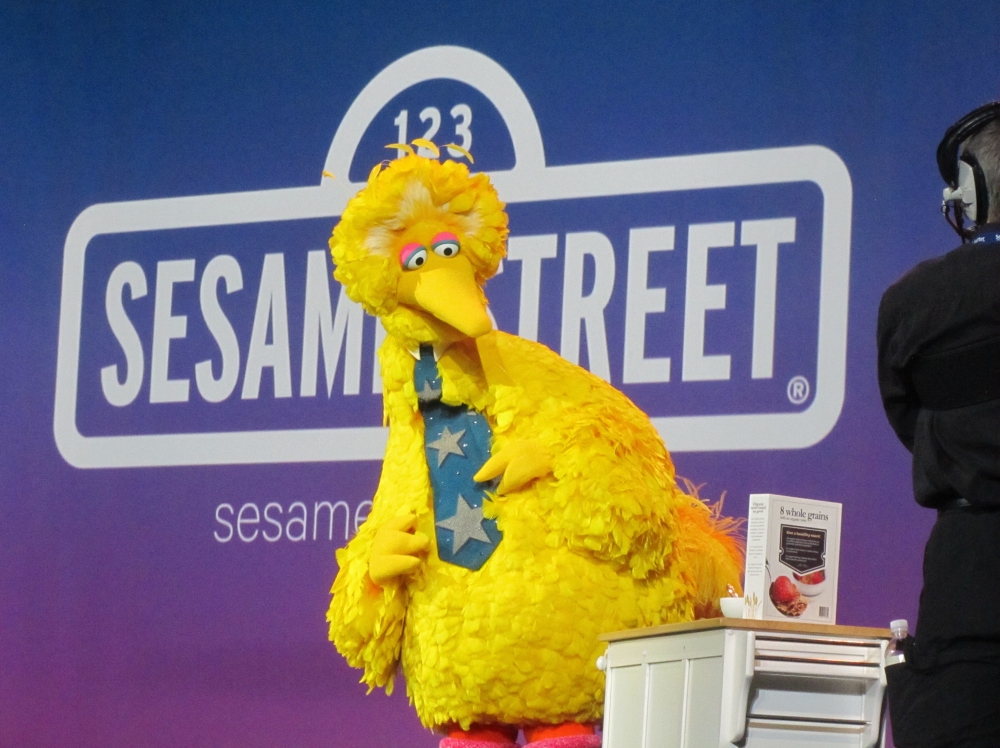
And Qualcomm CEO Paul Jacobs should have been the one interacting with Big Bird from “Sesame Street,” not some weird flunky.
I liked the Qualcomm keynote because it was unpredictable and had a lot of energy. The company was at least trying to be entertaining. It was preferable to the opening night keynotes in years past from Microsoft CEO Steve Ballmer. Those were snoozefests with the only entertainment coming from an occasional technical glitch.
I liked the segments in the Qualcomm keynote featuring movie director Guillermo del Toro (I love his work) and “Star Trek Into Darkness” actress Alice Eve (awkward as her scripted interchange with Jacobs was). And the performance by Maroon 5 at the end was a treat.
I also found Qualcomm’s announcements about its next-generation Snapdragon processors to be pretty illuminating.
Interestingly, a later article by the Verge called the Qualcomm event the “best press event” of CES 2013 for many of the reasons I just stated. So, get your story straight, guys.
“Blade 2” remastered for ultra HD
Director Guillermo del Toro discussed taking “Blade 2” (2002) from the film vaults and remastering an ultra HD version of it. People will be able to see the vampire superhero movie “exactly as it was intended to be seen,” he said.
The subject came up as Qualcomm was talking about chips for watching ultra HD video on smartphones and tablets, made possible by its latest mobile processors.
“Don’t go to the prime rib buffet after this,” del Toro warned the crowd before showing a gory clip.
Great performance by Maroon 5
Pop rock band Maroon 5 performed three songs in an acoustic set during the Qualcomm keynote event. Adam Levine sang “One More Night,” “This Love” and “Payphone.”
Qualcomm CEO Paul Jacobs joked after their set that “Payphone” wasn’t appropriate for his speech about mobile technology. “I think that song should be called ‘Cellphone’ not ‘Payphone.’ That would be more mobile,” he said.
Levine said the group should have been called Maroon 3 for the evening because it included just him, lead guitarist James Valentine, and BJ Morton on keyboards.
Sign that CES is tragically unhip
One sign of how uncool CES was this year was the decision to play Psy’s overexposed “Gangnam Style” at media events for Qualcomm and Dish Networks.
Before another major media event at CES, the organizers played LMFAO’s equally overplayed “Party Rock Anthem.”
Have younger people choose the music, guys.
Funniest original video played at a keynote: Samsung
During its keynote presentation, Samsung Electronics played a very funny video that blamed the explosion of Internet traffic on cat videos. It wasn’t an original idea, but the cat videos were hilarious.
I won’t stop calling it the Consumer Electronic Show
The CEA has been urging media for years to stop calling its conference the Consumer Electronics Show. The official name is International CES, or CES on second reference.
When I tell people I’m going to CES, they say, “What’s that?”
Then I say, “The Consumer Electronics Show,” and they immediately know what I’m talking about.
The organizers obviously want to broaden the show to include other things like software, home appliances, cars and other technology. But the show is predominantly a consumer electronics event.
It’s not like American Telephone and Telegraph or International Business Machines, which changed their names because they weren’t relevant to what they did anymore.
So, I’m going to keep calling it the Consumer Electronics Show.
Most embarrassing tech gaffe at company press conference: Sony
For the big unveil at Sony’s press conference at CES, stage hands rolled out a prototype 56-inch 4K OLED TV. It’s the world’s largest in a category that combines two hot display trends: 4K, or ultra HDTV, and organic light-emitting diode screens.
But the set suffered a technical glitch and showed an interface screen before going into Microsoft’s black screen of death. Sony CEO Kaz Hirai joked that the display was great for showing off user interfaces.
Technicians tried to fix it on the spot, but they soon gave up, turned it off and wheeled it to the side of the stage. It was working fine at the Sony booth for the show.
The Seattle Times published a good article on the incident. And DigitalVersus has some decent photos of it.
Stupid back-to-the-future moment: Samsung
Journalists chuckled at Samsung’s CES press conference on Monday when an executive said the company had just coined the term “T-commerce.”
The concept of electronic purchasing through your TV has been around since at least early 1994 when Time Warner Cable began testing its interactive TV system in Orlando, Fla. Industry officials started calling TV-based purchasing T-commerce after Amazon.com and e-commerce became a big deal.
But Joe Stinziano, executive vice president of Samsung Electronics America, apparently was unaware of all previous efforts at T-commerce.
“We’re also introducing an entirely new way to interact with your TV. We call it T-commerce,” he said. “For instance, while watching the hit Fox show “New Girl,” viewers will be able to learn about Jess’ latest outfit and even purchase it with the click of a remote.”
I remember seeing demos for this sort of thing years ago at tech conferences, only the example they typically used was buying a sweater or outfit you saw on the then-current show “Friends,” which ran from 1994 to 2004.
Most cringe-inducing moment: Panasonic
Joe Taylor, chief executive of Panasonic North America, couldn’t stop raving about Newark, N.J., Mayor Cory Booker. It was embarrassing.
Booker, a rising political star in the Democratic Party, appeared at Panasonic’s keynote event to discuss the company’s decision to move its U.S. headquarters to Newark.
Why Newark?
“It wasn’t financial. We had a number of opportunities that from a fiscal perspective were certainly much better. But none of those other cities had Mayor Booker,” Taylor said.
Taylor described Booker as a “visionary mayor.”
“In life, we need people who are incredibly smart, who are incredibly good looking or incredibly talented athletically. And that’s great one by one, but is it fair that one person should have all of those things?” Taylor gushed.
Journalist Lisa Ling, serving as host of the Panasonic event, said Taylor had a “man crush” on Booker. “It’s OK if you have a little man crush on Cory Booker,” she said. “We’re secure in our masculinity here.”
Best company-sponsored concert: Monster
Monster Cable held an invitation-only concert with Alicia Keys at the Paris Ballroom in the Paris Hotel on Wednesday Jan. 9. I managed to snag a press ticket.
Her hour-long set was terrific. She sang all her big hits including “Empire State of Mind (Part II) Broken Down” and “Girl on Fire.”
I read that Kesha performed at Clear Channel’s iHeartRadio event, but only did a measly three-song medley and was gone.
Biggest disappointment: No star-power at Sony media event
Sony’s media event on press day at CES usually features actors from the company’s upcoming movies and musicians from its record label.
In recent years, actors Will Smith and Seth Rogen and singers Taylor Swift and Kelly Clarkson have appeared on stage at Sony’s event. But this year, it had no star power at all.
Perhaps new CEO Kaz Hirai is trying to save money or is preparing to sell off its movie and music units to shore up the struggling conglomerate.
Now my TV will think I’m gay, too
I’ve written several times on Tech-media-tainment about how Netflix’s movie recommendation engine thinks I’m gay. For the record, I’m not. (See posts from 2008, 2009, 2010 and 2011.)
At CES this week, Samsung and Panasonic announced smart TV systems that will make recommendations of shows to watch based on past viewing behavior as well as programs friends have watched and rated.
Hopefully they’ll do a better job than Netflix. Just because I like movie musicals and NBC’s TV show “Smash” doesn’t mean I want to watch gay-themed videos.
Photos:
Samsung’s 85-inch Ultra HD, or 4K, TV with distinctive easel design and integrated speakers (CEA);
Qualcomm CEO Paul Jacobs and actress Alice Eve (Patrick Seitz photo);
Big Bird from “Sesame Street” at Qualcomm keynote (Patrick Seitz photo);
Maroon 5 at Qualcomm keynote (CEA);
Sony’s booth at CES 2013 (Patrick Seitz photo);
Sony’s prototype 56-inch 4K OLED TV suffers a technical glitch (Patrick Seitz photo);
Microsoft error screen on Sony 4K OLED TV at CES 2013 (Patrick Seitz photo);
Alicia Keys at Monster party at CES 2013 (Contactmusic.com);
Promo art for NBC’s “Smash” starring Katharine McPhee.
Labels:
CES,
kesha,
microsoft,
movies,
netflix,
panasonic,
popular music,
qualcomm,
samsung,
sony,
taylor swift,
tv shows
Friday, January 11, 2013
CES buzzword of the year: Super
For the last few years, I’ve highlighted the most common buzzword tossed around at the annual Consumer Electronics Show in Las Vegas.
This year, the word most frequently used to describe hot new technologies at the show was “super.”
In 2010, when environmental and energy concerns burst on the scene, “green” was the buzzword or cliche used by companies at the show. In 2011, every technology seemed to be described as “smart.” In 2012, “ultra” was the most overused word to describe new products.
Here are some super examples from the show, which ended Friday:
Photo: Microsoft CEO Steve Ballmer describes the company’s Windows RT devices as “super fast and fluid,” during Qualcomm’s keynote event.
This year, the word most frequently used to describe hot new technologies at the show was “super.”
In 2010, when environmental and energy concerns burst on the scene, “green” was the buzzword or cliche used by companies at the show. In 2011, every technology seemed to be described as “smart.” In 2012, “ultra” was the most overused word to describe new products.
Here are some super examples from the show, which ended Friday:
- Qualcomm CEO Paul Jacobs called the company’s new Snapdragon 800 series processor “the first super premium processor for smartphones, tablets and computers.”
- Sharp Executive Vice President Kozo Takahashi said the company’s new LCD technology, Igzo, renders video in “super high definition.”
- Sharp calls its new display feature that boosts panel brightness by 50% its SuperBright technology.
- Sony CEO Kaz Hirai said the company’s new Xperia Z handset offers a “true superphone experience.” Sony Electronics President and COO Phil Molyneux also called the Xperia Z a “superphone.”
- An advertisement by graphics chip company Nvidia at the show describes the broad usage of its chips with the slogan “From Super Phones to Super Cars.”
- Mobile accessories company Dexim introduced its Super-Juice power case for the iPhone 5.
- Netflix announced that it is offering “super HD” streaming video for 1080p high-definition televisions.
Photo: Microsoft CEO Steve Ballmer describes the company’s Windows RT devices as “super fast and fluid,” during Qualcomm’s keynote event.
Saturday, January 9, 2010
Time to boot Microsoft from the opening keynote slot at the Consumer Electronics Show
The producers of the Consumer Electronics Show should give serious consideration to awarding their high-profile opening night keynote speech next year to a company other than Microsoft.Microsoft has had that slot for many years at the annual trade show. It made sense when the speech was given by Microsoft co-founder and visionary Bill Gates, one of only a handful of rock stars in the tech business. But he’s since retired from daily operations at the company to focus on his philanthropic work.
For two years in a row, Microsoft CEO Steve Ballmer has given the speech. Ballmer is a powerful business figure, but he doesn’t have the iconic status that Gates does.
Microsoft’s keynote on Wednesday was a lackluster affair, highlighted more by taped comedy bits from “Saturday Night Live” comic Seth Meyers than by killer products or concepts.
The tech world just doesn’t revolve around Microsoft like it used to.
Compare Microsoft’s keynote with those of Intel CEO Paul Otellini and Qualcomm CEO Paul Jacobs at this year’s CES, which ends Sunday. Intel and Qualcomm showed how they are creating platforms and enabling technologies from which many other companies can benefit.
And those Intel and Qualcomm technologies nailed all the hot technologies at the 2010 CES: netbooks, web tablets, e-readers, smart phones, 3D TV and mobile digital TV. They paraded a host of new products and partner companies out on stage with them.
Intel and Qualcomm each demonstrated how they are creating ecosystems around their technologies that could drive the consumer electronics industry forward.
Microsoft offered little to excite attendees this year.
Its biggest announcement was an exclusive deal with Hewlett-Packard where Microsoft’s Bing will be the default search engine on new HP PCs and Microsoft’s MSN will be the default web homepage.
Ballmer teased the audience with a slate PC prototype from HP, but didn’t offer specifics or conduct an in-depth demo.
Microsoft also disclosed holiday 2010 availability for its previously announced Project Natal motion-detecting, controller-free interface for the Xbox video game console. But no pricing was revealed and no new demo offered. (Its original demo of Natal last June wowed the crowd at the E3 video game show in Los Angeles. They’re probably saving the next demo for E3 2010.)
Ballmer discussed the success of Windows 7, Microsoft’s latest PC operating system, released in October. But that’s nothing new or surprising.
In hindsight, a much better choice for the opening keynote would have been Google CEO Eric Schmidt and/or co-founders Larry Page and Sergey Brin.
Google is rocking the consumer electronics world now with its Android operating system for smart phones and web tablets, its Chrome OS for PCs and its innovation around web software. Plus, it’s grabbing headlines for its massive book digitization project and the growth of its YouTube video website.
Microsoft is a powerful company and a big exhibitor at CES, so they might not take kindly to losing the kickoff keynote.
But CES organizers need to choose keynoters from companies having the most impact on consumer electronics today. Being able to generate excitement among attendees is an important consideration as well.
Photo: Microsoft Chief Executive Steve Ballmer demonstrates a Hewlett-Packard slate computer prototype Wed. Jan. 6, 2010, at the Consumer Electronics Show in Las Vegas. (Photo by Microsoft.)
Subscribe to:
Posts (Atom)