Showing posts with label memory lane. Show all posts

Saturday, February 7, 2026

Newspapers I used to work for and what’s become of them


My professional career has been in two parts. The first was after I earned a bachelor’s degree in journalism from the University of Illinois, Urbana-Champaign, and worked for daily newspapers. The second was after I earned a master’s degree in journalism from Northwestern University in Evanston, Illinois, and then worked for trade and business media.
I don’t include the first part of my career on my LinkedIn profile. It was fun, educational and helped hone my stills in reporting, writing and editing, but it really doesn’t pertain to my current focus.
But lately I’ve been thinking about those print media days. I still have boxes of “clips” of articles from those years. I’ll probably just end up throwing them away at some point.
What spurred my nostalgia was recent headlines. The Atlanta Journal-Constitution just stopped printing a paper newspaper after 157 years and the Washington Post is slashing its staff amid a shrinking business.
It’s a tough time for print journalism after decades of business erosion due to the internet.
As an undergraduate student at U of I in the early 1980s, I worked at the Daily Illini student newspaper, which then published five days a week. Apparently it now only prints a weekly edition, called The DI, on Wednesday and is mostly focused on online news, which makes sense.
After college, I worked for the Small Newspaper Group, owned by the Small family out of Kankakee, Ill. I started at the Streator Times-Press in central Illinois. I worked there for two years (1984-86) before moving to the Daily Dispatch in Moline, Ill., and shortly thereafter the Rock Island Argus.
The Streator newspaper merged with its bigger sister newspaper in Ottawa, Ill., to serve the greater LaSalle County, Illinois, area, in September 2005.
In March 2018, Shaw Media bought the combined newspaper. (See articles by the AP, Streator Chamber of Commerce, and Dirks, Van Essen & Murray.)
I have fond memories of working in Streator, an industrial and farming community. One large factory there made glass bottles. There was a bar across the street for workers that I would go to. The bartenders would pour beer from bottles, which they would toss in a chute on the wall behind them. The bottles would smash as they fell into a container on the other side, presumably to be recycled to make new beer bottles.
When I moved to the Quad Cities to work for the Daily Dispatch and Rock Island Argus (1986-92), I lived in East Moline, Ill.
An industrial Midwest hub located on the Mississippi River dividing Illinois and Iowa, the Quad Cities are made up of Davenport and Bettendorf, Iowa, and Moline and Rock Island, Illinois. There are lots of great parks and restaurants there and it is home to agriculture giant John Deere.
The two sister newspapers eventually merged operations. And in June 2017, Lee Enterprises, publisher of the rival Quad-City Times in Davenport, bought out its cross-river competition from the Small family. (See articles by Our QC News, the Quad-City Times, KWQC and Milwaukee Journal Sentinel.)

Photos: My profile of Jim’s Rib Haven from the April 28, 1991, edition of the Rock Island Argus. I was saddened to hear that Jim’s Rib Haven has since closed.


Saturday, January 24, 2026

‘The Wizard of Oz at Sphere’ was amazing. But what’s next?


The reimagined version of the classic MGM musical “The Wizard of Oz” at the Sphere in Las Vegas is an amazing experience. And it makes you wonder: What could the innovative surround-experience theater do with other old movies?
I watched, rather, experienced “The Wizard of Oz” at the Sphere earlier this month. The beloved 1939 film was digitally upgraded into an immersive movie that dazzles the senses. It fills your field of vision, allowing you to look up and around in the worlds of Oz and Kansas.
It also whips up the wind and blows leaves for the tornado sequence and drops foam apples when the angry apple trees are throwing fruit at Dorothy. Robotic butterflies and flying monkeys also cruise above the audience during their scenes. Plus, the seats rumble and there are other effects.
“The Wizard of Oz at Sphere” has sold 2 million tickets since it bowed on Aug. 28, 2025, raking in more than $260 million in ticket sales, the Hollywood Reporter said.
So what’s the next classic film to get the Sphere treatment? Some have suggested “Star Wars” or “Jurassic Park.”
But I think a good one would be the classic movie musical “Willy Wonka & the Chocolate Factory” (1971). I’d pay to see that at the Sphere.
Meanwhile, Sphere Entertainment Co. on Jan. 18 announced its intent to build a second U.S. Sphere venue, using a smaller-scale design, at National Harbor in the Washington, D.C. metropolitan area. It will have 6,000 seats vs. about 18,000 seats at the Las Vegas Sphere.
The company had earlier announced plans to build a Sphere arena in Abu Dhabi.

Photos: Promotional art for “The Wizard of Oz at Sphere” (top); artist's depiction of the Sphere at National Harbor.


Sunday, October 19, 2025

Chicago Is Hot Dog City


No city loves its hot dogs as much as Chicago, “hog butcher for the world” as Carl Sandburg wrote in his poem “Chicago.” Though the go-to frank there is the Vienna Beef wiener.
On a recent trip back to Chicago, I visited two famous hot dog joints in the northern neighborhoods of Chicago: Superdawg Chicago in Norwood Park East and Wolfy’s in West Ridge.
In August, I stopped by another famous Chicagoland hot dog restaurant, Gene & June’s in River Grove, Ill.
The experience for each was unique but all of them offered delicious meals with their own twist on the Chicago-style hot dog.
The traditional Chicago-style hot dog features an all-beef frankfurter on a poppy seed bun, topped with yellow mustard, chopped white onions, bright green sweet pickle relish, a dill pickle spear, tomato slices or wedges, pickled sport peppers and a dash of celery salt.
One of the quintessential downtown Chicago hot dog joints is The Weiners Circle in Lincoln Park. It’s known more for its sass and satirical promotions than its food. The late night crowd can get pretty rowdy, according to locals.
Chicago is known for other meaty fast-food delicacies as well including the Italian beef sandwich, Maxwell Street Polish sausage and the gyro sandwich.


Related article:

Ode to Chicago-style hot dogs (Aug. 31, 2025)

Sunday, August 31, 2025

Ode to Chicago-style hot dogs


Thanks to the expansion of the Portillo’s restaurant chain outside of Chicago, people across the country can now enjoy Chicago-style hot dogs without having to venture to the Windy City. I love those “dragged through the garden” franks.
When I was living in Wilmette, Ill., my go-to hot dog joint was Irving’s For Red Hot Lovers. It’s got the traditional Chicago-style beef hot dog topped with yellow mustard, bright green sweet pickle relish, chopped white onion, tomato slices, a dill pickle spear, pickled sport peppers, and a dash of celery salt on a steamed poppy seed bun.
On my regular visits to Chicagoland, I like to stop for a dog and fries at Superdawg in Wheeling, Ill.
On my most recent visit this month, I decided to go to one of the most storied hot dog stands in all of Chicago – Gene & June’s in River Grove, Ill. I was not disappointed.
I ordered the double-dog with fries. Gene & June’s tops its franks with mustard, relish, onion and sport peppers. It’s a good hot dog, but the fresh cut and made French fries are the true standout here.


Sunday, August 17, 2025

Free web platforms are preserving digital artifacts … for now


Over the years, I have spotlighted 450 websites that I found to be useful, educational or entertaining. Many of the early websites have disappeared without a trace because they stopped paying services to maintain them.
But those that set up shop on free platforms such as Google’s Blogger or social media services like Facebook, Instagram and Twitter/X are still around, even if they haven’t been updated in years. That means the content on those sites is being preserved in a digital time capsule.
I can only hope that the companies behind those free, ad-supported services will continue to keep those websites alive, even when the creators are long gone. But there are no promises like that in the digital age.
Of the 450 websites that I’ve highlighted on Tech-media-tainment since late 2008, 117 are no longer reachable or the data is gone. Three of the websites have gone dark since the last time I checked in February 2025.
A good example of a website that is being preserved is the Twitter/X account of anti-Islam demonstrator Salwan Momika. He risked his life to speak out against the threat of Islamic culture to Western society. He was murdered on Jan. 29, 2025, during a live broadcast on TikTok. His Twitter/X account still exists thankfully. Hopefully his other social media accounts do as well.
It is important to preserve the voices and opinions of people from throughout the years. They are useful for tracking the progress of humanity and also for sentimental purposes.
I still keep voicemails on my iPhone from my mother, who died in January, just to hear her voice every now and then. I also keep old emails from friends and loved ones.

Photo: Salwan Momika burning the Quran in Stockholm on Oct. 21, 2023. (Photo by Frankie Fouganthin via Creative Commons.)

Sunday, August 3, 2025

AI summaries are the latest existential threat for news publishers


When I was studying for a print journalism degree in the mid-1980s, newspapers were already in decline. It didn’t deter me from that line of work but it was worrisome.
At the time, broadcast and cable television news were lessening demand for newspapers, especially in major metropolitan areas. It turned out to be one of a series of crises to face the news industry over the years.
When I graduated from the University of Illinois, Urbana-Champaign, in 1984, PCs weren’t yet commonplace. The early days of the internet with AOL, Yahoo and the like would create the next crisis for newspapers. But publishers adapted and shifted their operations to the web. And as the internet evolved, they learned how to attract readers and game the Google algorithm using search engine optimization. At the same time, advertising shifted to the web.
The immediacy of the web has great advantages over the dead-tree editions of the news. I imagine that as more Baby Boomers die off so will the newspapers they grew up with.
But now digital publications, including legacy newspapers, are facing their next existential threat from generative artificial intelligence. Google searches now generate AI summaries of news and information requests. And that has led to fewer clicks on weblinks back to the source of the news and information. The result is fewer readers, less advertising revenue and fewer opportunities to sell subscription services.
One recent study found that U.K. publishers are seeing click-through rates cut by nearly 50% because of AI summaries.
Google disputes the results, calling the study inaccurate and based on flawed assumptions, according to Press Gazette.
Still, publishers in the U.S. and elsewhere are seeing a decline in traffic. Many readers might get all the information they’re looking for on a subject from an AI summary.
This has led to a corresponding loss in advertising revenue. News publishers have responded by cutting journalism jobs. The Press Gazette has been tracking the layoffs.
Some publishers are demanding payment for use of their content to create AI summaries. But that would probably only help the largest news companies that have the legal resources to fight Big Tech.
AI summaries will need to do a better job of sourcing in their responses to encourage a click-through for more information.
Online publishers already are preparing for a day called “Google Zero,” when Google stops sending traffic to websites.

Related articles:

Google users are less likely to click on links when an AI summary appears in the results (Pew Research; July 22, 2025)

News Sites Are Getting Crushed by Google’s New AI Tools (The Wall Street Journal; June 10, 2025)

Google search algorithm changes hurting small publishers (Tech-media-tainment; March 1, 2025)

Photo: Online news illustration (Mike Licht via Creative Commons)

Thursday, July 31, 2025

Old newspapers need to be digitized


I recently tried to locate a newspaper article from the 1970s the old fashioned way – in a public library on microfilm. I was unsuccessful in my hunt.
The process was laborious and I eventually gave up after looking through several years’ worth of weekly newspaper issues.
I was trying to find an article that I had only a vague recollection about. When I was growing up in Libertyville, Illinois, a local newspaper did an article on my mother and her experiences raising seven children. The article by the Independent-Register newspaper was published sometime between 1972 and 1980.
The newspaper is no longer in operation. All that’s left are decades of print issues on spools of microfilm.
But trying to find an article with the broad time period that I had is extremely difficult. I even narrowed my search to around Mother’s Day for those years, figuring that was the reason the article was written. But I came up empty. I began to question whether the article even existed and somehow my memory was faulty. After all, I was in junior high or high school at the time.
If the newspaper had been digitized, the search could have been done in seconds. But who’s going to digitize some old suburban newspaper from microfilm? These publications are basically orphan works now.
Maybe one day, the cost for digitizing publications on microfilm will come down and some historical society will do the job. But they should do it before something happens to the microfilm libraries, otherwise the information within will be lost to the ages.

Photo: A publication on microfilm. (Microfilm Imaging Systems)

Saturday, July 19, 2025

The news media oversimplifies business competition


In trying to capture the attention of readers, the news media often oversimplifies the nature of business competition as one of winners and losers.
I’ll admit to doing this as well. But as a stock-focused technology business writer, it’s easier for me to point to companies doing well on the market and compare them to those that aren’t.
In a recent interview, streaming media industry analyst and consultant Dan Rayburn told me that he doesn’t like the popular phrase “streaming video war,” much less crowning Netflix the “winner.”
“As a soldier, someone still tied to the military, war is not good,” he said. “But what we have amongst all these streamers is competition. Competition is great.”
He added, “The media uses that (phrase) because it makes it sound worse than it is. It’s not a war – it’s competition. Competition breeds great things for consumers.”
And further, Netflix is not the only winner. It may have the largest global subscriber base, but others have been successful in the market. He pointed to Alphabet’s YouTube as another highly successful video streamer, one which takes a different approach to the market with ad-supported videos.
On May 9, AMD Chief Executive Lisa Su spoke to students, faculty and guests at Rensselaer Polytechnic Institute in Troy, N.Y. She was asked about her company’s competition with Nvidia.
“I don’t view these things as zero-sum games,” she said. “The media tends to want to make these very critique conversations. It’s AMD vs. Intel or it’s Nvidia vs. AMD.”
“I don’t think we should think about it that way,” she said. “We should think about things as: the world needs more compute … And there are very few companies that build compute.”
Wise words.

Photo: AMD Chief Executive Lisa Su speaks at Rensselaer Polytechnic Institute in Troy, N.Y., on May 9, 2025. She was interviewed by RPI President Martin Schmidt at the President’s Commencement Colloquy. (Patrick Seitz)

Tuesday, March 4, 2025

Online content not safe from deletion


When I was starting out in the news business and worked at daily newspapers, older articles were available in bound copies of newspaper editions.
Much older articles were saved to microfilm or microfiche. You had to use special machines to read the miniaturized reproductions and to make photocopies.
There was no computer text search so you had to know the date or approximate date of the article or event to find what you needed.
The good news was that there was a permanent record of what had been reported on and written about.
Many journalists, including myself, kept physical “clips” of the articles from the newspapers and print publications that they worked for.
The rise of the internet brought with it the wonders of computer-aided search. All was good until databases like news website archives started going offline. That has led to the scourge of broken weblinks and unavailable information.
Solutions for the problem include archiving organizations such as the venerable Internet Archive. Others include Archive.Today, Archive Team and Webrecorder. But content owners must take advantage of those services.
And those are just Band-Aid fixes to a bigger problem.

Photo: Pew Internet Research chart from Chartr.

Related articles:

How to disappear completely. The internet is forever. But also, it isn’t. What happens to our culture when websites start to vanish at random? (The Verge; Dec. 18, 2024)

The internet is littered with ‘dead links’ (Fast Company; May 28, 2024)

Spotify’s layoffs put an end to a musical encyclopedia, and fans are pissed (TechCrunch; Feb. 12, 2024)

CNET Deletes Thousands of Old Articles to Game Google Search (Gizmodo; Aug. 9, 2023)

Spotify is shutting down Heardle, the Wordle-like music guessing game it bought last year (TechCrunch; April 14, 2023)

Saturday, June 22, 2024

K-pop filling a gap for boy bands and girl groups


I recently attended a concert with my daughter for Korean boy band Tomorrow X Together at Capital One Arena in Washington, D.C. A good number of K-pop acts have been touring the U.S. in recent years including girl groups Aespa, Blackpink, (G)I-dle and Itzy and boy bands Monsta X, NCT Dream and TXT.
What’s behind the rise in the popularity of K-pop groups?
My guess is that K-pop is filling an unmet demand among young people for single-sex music and dance groups because the U.S. and Europe aren’t producing them now.
Such acts used to be plentiful in the U.S. and U.K. There were boy bands Backstreet Boys, Boyz II Men, NSync, New Kids on the Block and One Direction. And there were girl groups like Destiny’s Child, En Vogue, Fifth Harmony, Pussycat Dolls and the Spice Girls.
So until the West produces the next wave of such musical groups, expect K-pop to dominate the category.

Photo: TXT promotional poster.

Wednesday, September 27, 2023

Shirley Temple doll is an unusual family heirloom


The prologue to the hit summer movie “Barbie” notes that girls’ dolls before Barbie debuted in 1959 were all baby dolls. They were designed to teach maternal skills to young girls and reinforce gender roles. But that’s not entirely true.
When my mom was 7 years old in 1940, she received a 27-inch-tall Shirley Temple doll as a Christmas gift from her aunt Josephine. The doll captures the likeness of the precocious Hollywood child actress. Girls treated their Shirley Temple dolls as companions and playmates.
“She was very popular at the time,” my mom told me. In fact, Temple was Hollywood’s number-one box-office draw as a child actress from 1934 to 1938.
Shirley Temple dolls also were popular in that period. “The one I had was not the most expensive one,” Mom said.
When my mom moved into senior housing she gave away many of her possessions to her children. Because I’m something of a pop culture historian, the doll went to me.
The 83-year-old Shirley Temple doll was restored a few years back.
“It got moved around a lot from Jim Falls to Chippewa (Wisconsin) and then my mother kept it when they moved out to the country there,” Mom said. She retrieved the doll after her mother died.
Now that I’ve got the doll, I’m having to put up with a lot of Annabelle jokes. But Shirley isn’t creepy at all. I swear.

Photo: 1940 Shirley Temple doll. (Patrick Seitz)

Wednesday, December 15, 2021

Visit to University of Illinois at Urbana-Champaign an eye-opener


I graduated from the University of Illinois at Urbana-Champaign in 1984 and hadn’t been back to campus in nearly 31 years until my visit on Saturday Dec. 11.
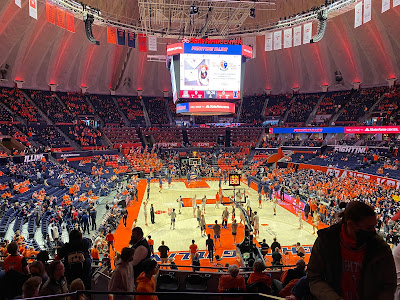
It was a chilly, yet mostly sunny day at U of I when two fellow graduates and I toured our old haunts. We were in town to watch the Fighting Illini men’s basketball team host the University of Arizona Wildcats at State Farm Center, formerly Assembly Hall. Unfortunately, the Illini lost 83 to 79.
The weather was a lot better than my last trip to campus on Dec 22, 1990. On that date, I met up with a friend to watch the Illini defeat the Louisiana State University Tigers, led by Shaquille O’Neal. I had to drive back to the Quad-Cities that night in a blinding snowstorm. That was one of the scariest driving experiences of my life.
The U of I campus has changed significantly since my last visit. For instance, north of the Illini Union is a greatly expanded computer science and engineering area.
The Illini Union has kept its stately entrance area but remodeled much of the interior with new facilities for studying, recreation, commerce and just hanging out. When I was there, the union had a Plato terminal in the front hall. Plato was a computer network before the internet.
The Main Quad looked the same and so did the surrounding historic buildings such as Altgeld Hall, Foellinger Auditorium and Gregory Hall.
But many familiar businesses from my days as a college student in the early 1980s are long gone.
Garcia’s Pizza in a Pan is no longer on Wright Street near Green Street, across from the Alma Mater statue. (Garcia’s is now in northwest Champaign. The once large regional pizza chain is now down to just two locations in central Illinois, according to the News-Gazette.)
Papa Del’s Pizza is no longer on Wright just north of Green. (It’s in a new, larger location west of campus on Neil Street.)
Even Kam’s bar, “The Home of the Drinking Illini,” on East Daniel Street is gone and the building demolished for new construction. Kam’s was a hangout mostly for members of fraternities and sororities, aka Greeks. It has moved to a new location at First and Green streets, further away from the university.
Another bar that’s kaput is Cochrane’s, which was known for its Little King’s beer nights, offering three small beers for $1. It was located on Wright just north of Green.
Also gone is Mabel’s, a nightclub where as students we had watched Jay Bennett from our dorm floor at Taft Hall play. Bennett later was a member of Wilco.
The Campustown area has seen the most changes with numerous high rises replacing one- and two-story buildings. Other places we used to hang out are gone as well including the Space Port video game arcade, Taco John’s, the Co-Ed movie theater, and a record store that sold new vinyl LPs and cassettes.
On Saturday, we had lunch at Murphy’s Pub, which has expanded its Green Street location since we were students.
The Daily Illini campus newspaper has moved a couple of blocks south from its location in the basement of a building on John Street near Wright. I spent many hours in the newsroom there as a student both working and writing school papers.
The U of I campus looks more metropolitan since we were students. Back then, it was a major university located between a couple of midsize towns amid the cornfields of central Illinois.

Photos: Foellinger Auditorium as seen from across the Quad at the Illini Union (top); exterior and interior of State Farm Arena (bottom) (Patrick Seitz)


Sunday, April 19, 2020

Covid-19 the latest scary disease to target humans

The Covid-19 coronavirus pandemic has officially killed nearly 166,000 people worldwide and sickened more than 2.4 million to date, according to Worldometer. The actual numbers are probably much higher, due to under-reporting by China, where the disease originated, and lack of testing supplies.
The global response to combating Covid-19 has been unprecedented, with governments shutting down non-essential businesses and warning people to wear masks, social distance and self-quarantine. It could permanently change how people work, play and school.
The pandemic also is likely to spark an increase in people seeking careers in virology and immunology.
Communicable diseases are scary things. Some of the terrible diseases my parents grew up worrying about like smallpox and polio have been vanquished by medical advances. Others like measles are making a comeback thanks to the irrational anti-vaccination movement.
My maternal grandfather, William O. Kelly, had polio as a young man. He had to learn how to walk again. He eventually recovered, got married and fathered my mother. Thank God for that!
Covid-19 caught governments unprepared even though we have had warnings for years. Most recently there was the swine flu pandemic that killed 200,000 in 2009-10.
But the outbreak most historians point to is the 1918 Spanish flu pandemic. The worldwide death toll from the Spanish flu is estimated to have been anywhere from 17 million to 50 million, and possibly as high as 100 million.
Meanwhile, few Americans know about the Asian flu pandemic in 1957-58 that killed 1.1 million worldwide, including 116,000 in the U.S. That’s likely because the U.S. was ready with a vaccine before that strain of the flu hit here.
My mother, who’s now 87 years old, doesn’t recall that flu outbreak. At the time, she was raising two young children in Madison, Wis., while her husband and my to-be father was getting his Ph.D. at the University of Wisconsin.
“It didn’t impact us at all. I don’t even remember it,” she said recently. “Everything is so different now because of the kind of media we have. Something happens and five minutes later it’s on the news.”
And air travel wasn’t as prevalent in the late 1950s either. That helped spread Covid-19 so rapidly worldwide.
I was born in 1962 and remember certain diseases scaring me. I saw a movie or TV drama series episode about a man spreading diphtheria in a big city that shook me. I also was frightened of leprosy after watching an epic Bible movie.
I recall staying home from elementary school when I was sick with the mumps.
I also was among the last U.S. elementary school classes to get the smallpox vaccine. I still have the scar on my upper left arm from the booster shot. Routine vaccinations for smallpox were discontinued in 1972 in the U.S. I can remember kids lining up in the gym to get their shot. Quite a few cried after getting it. Not me, but it did sting.
Unlike my older siblings, I didn’t get the measles or chickenpox.
“We had both the chickenpox and red measles around the same time,” my mother said. “One followed the other. I don’t remember which came first. One of dad’s friends or coworkers, his wife said to him, ‘Boy, Alice really got a double dose having them both together like that.’”
My siblings were confined to the house for about two weeks when they were sick with the measles and chickenpox in the late 1960s.
“I remember them all upstairs in our house in Royal Oak,” Michigan, she said. “I had three beds up there and that’s where they were. I had had it as a child, so I was immune.”

Related reading:

Visualizing the History of Pandemics (Visual Capitalist; March 14, 2020, and updated April 18, 2020)

How the 1957 Flu Pandemic Was Stopped Early in Its Path (History; March 18, 2020)

How Will Coronavirus Pandemic Deaths Compare to the 1957 Flu Pandemic? (Reason; March 31, 2020)

Photo: Covid-19 coronavirus (CDC image)

Sunday, June 23, 2019

Memories of growing up in Libertyville, Illinois, shared on Facebook

As much as I’d like to quit Facebook entirely because of the company’s horrendous record with user privacy, there are some things for which the social network is still very useful.
In addition to connecting long-lost friends, Facebook is very good for people who want to share special interests.
I don’t use Facebook to share personal information, but I do like to check out some groups that share memories of growing up in my hometown of Libertyville, Ill., and the Chicagoland area. I also belong to a group for my high school graduating class.
I subscribe to three Libertyville groups on Facebook, two of which are closed groups. They are: Vintage Libertyville (Illinois), Libertyville Memories of the 70’s and “You know you grew up in Libertyville, IL because you remember...”, of which the first two are private.
I also subscribe to Vanished Chicagoland on Facebook.
I especially like it when members share photos from the past in Libertyville, including pictures of distinctly Chicago or Libertyville things.
I’ve included some sample photos here. They include Glen Rock soda pop from Waukegan, a staple of my childhood; Highland Hornets button from Highland Middle School; postcard from the Hitch Inn Post Motel, where my family stayed when we moved to Libertyville from Minnesota; Jays Potato Chips from Chicago; advertisement from Chicago rock radio station The Loop FM 98; and a weekly top singles and albums list from pop music station WLS.


Sunday, May 5, 2019

K-pop music invasion brought to you by YouTube, social media

The Korean pop music invasion of the United States has picked up steam in recent months with tours by K-pop boy band BTS and girl group Blackpink.
You’d never know about the phenomenon if you listen to American radio, which is dominated by iHeartRadio. K-pop music doesn’t get airplay on the major U.S. radio stations.
Instead, K-pop reached its audience outside of Korea through YouTube and other online media.
On April 27, I attended the sold-out Blackpink concert in Hamilton, Ontario, with my 13-year-old daughter. The atmosphere was electric and the crowd filled with super fans of the quartet.
Blackpink members Jennie, Jisoo, Lisa and Rosรฉ performed their hit songs and danced up a storm. It was a slickly produced performance, complete with a killer house band, big video screens, multiple stage elevators, and the requisite lasers, fog machines and pyrotechnics. The crowd sang along and danced to their big hits, including “Ddu-Du Ddu-Du,” “Kill This Love” and “Whistle.”
The next day, by chance, we met the South Korean group at a restaurant at Toronto Pearson International Airport. We told them how much we enjoyed their show and they thanked us before we were quickly shooed away by their management.
Blackpink made their U.S. concert debut at Coachella on April 12. They then kicked off the North American leg of their “Blackpink In Your Area” world tour on April 17 in Los Angeles.
The group is performing in six North American cities. In addition to L.A. and Hamilton, they are making stops in Chicago, Newark, Atlanta and Fort Worth.
Blackpink is filling a void in girl vocal groups in the U.S. The music scene in the states at the moment is dominated by solo female artists, led by Ariana Grande and Taylor Swift. Blackpink is “squad goals” for young girls who’d like to belong to a tight-knit group of friends.

My Twitter coverage of Blackpink’s visit to Canada:

It’s happening #Blackpink (April 27)

Incredible show by Blackpink tonight. (April 27)

Blackpink performed hits like “Ddu-Du Ddu-Du,” “Whistle” and “Kill This Love.” (April 27)

Met the ladies of Blackpink at Toronto Pearson International Airport this afternoon. My 13-year-old daughter was thrilled. Nice surprise. No photos. Didn’t want to intrude too much. (April 28)


News articles about Blackpink and K-pop:

What the Rise of Black Pink and BTS Says About the Future of K-pop (Vulture; Aug. 28, 2018)

How Blackpink Booked a North American Arena Tour Before Playing a Single U.S. Show (Billboard; Feb. 20, 2019)

Why K-Pop Is Finally Breaking Into the U.S. Mainstream (Billboard; Feb. 28, 2019)

Inside Blackpink’s U.S. Takeover: How the K-Pop Queens Are Changing the Game (Billboard; Feb. 28, 2019)

With ‘Kill This Love,’ K-pop queens Blackpink have made YouTube and iTunes history (Vox; April 8, 2019)

Blackpink proves BTS isn’t the only K-pop group that can find success in US (USA Today; April 16, 2019)

Blackpink Proved Why They’re the Biggest Modern Girl Group (Jezebel; May 3, 2019)

Photos: Blackpink, tour announcement and cover of Billboard magazine.


Sunday, June 17, 2018

Remembering Sears, the one-time retail giant

One-time retail leader Sears doesn’t look like it’s going to be in business much longer. The struggling company recently announced another round of store closings.
One of the stores set to close is an anchor at the Hawthorn Mall in Vernon Hills, Illinois. I worked at that store in the catalog department in 1979 and 1980. I still have my Sears name tag somewhere.
Sears built its brand as a catalog firm. What products it didn’t have available in its retail stores you could probably find in its thick-book catalog.
In the part of the store I worked people would pick up the products they ordered by phone, mail or in person. I’d retrieve their packages and check them out at the register. I’d also call customers at home to let them know that their orders had arrived.
Sears missed a huge opportunity to dominate online when the commercial internet arrived. It had much of the physical infrastructure in place. Instead, Amazon and Walmart rose up to grab that business.
Chicago-based Sears ended its catalog business in 1993 because of sinking sales and profits, just before the consumer internet took off. Jeff Bezos founded Amazon.com in July 1994.
Sears wasted away because it failed to adapt to changing consumer tastes and technology. No enterprise can rest on past accomplishments. It must be willing to embrace change.

Related articles:

Sears, Kmart parent company to close another 63 stores as sales crisis continues (USA Today; May 31, 2018)

It was once the biggest retailer in the US. 125 years later, Sears looks a lot different (CNBC; May 18, 2018)

Photo: Store-closing sale at the Sears in the Dover Mall in Dover, Delaware, in May 2018. (Photo on Creative Commons from Dough4872 on Wikipedia entry on Sears.)

Thursday, May 17, 2018

Popular songs today are more depressing than those from three decades ago

Researchers at the University of California, Irvine, have determined that modern pop music is more depressing than tunes from three decades ago.
Their study determined that music from 2015 is about 20% more unhappy than it was in 1985. Researchers looked at the lyrics and acoustic properties of hundreds of thousands of songs and came to the conclusion that music isn’t has happy as it used to be. (See articles by AP, Paper and the Daily Mail.)
Judging from the current list of hit songs, the trend is continuing. The top 10 songs in the U.S. this week include such downers as “This Is America” by Childish Gambino, “Psycho” by Post Malone, and “No Tears Left To Cry” by Ariana Grande.
Coincidentally, iHeartRadio is publicizing an application called Graduation Playlist that lets you see what songs were popular in the year you graduated from school.
My high school graduation year (1980) included such hits as “Any Way You Want It” by Journey, “Another Brick in the Wall, Pt. 2” by Pink Floyd, “Heartbreaker” by Pat Benatar, “What I Like About You” by The Romantics, “Brass In Pocket” by The Pretenders, “Train in Vain” by The Clash, “He’s So Shy” by The Pointer Sisters, “Upside Down” by Diana Ross, “Refugee” by Tom Petty and the Heartbreakers, “Misunderstanding” by Genesis, “Hungry Heart” by Bruce Springsteen, and “Boulevard” by Jackson Browne.

Saturday, April 29, 2017

Great American road trip: Las Vegas to national parks and back again

For spring break vacation, my family and I flew to Las Vegas and took a road trip to the nearby national parks. We had a great time.
In Las Vegas, we saw the Britney Spears show “Piece of Me” at the Axis Theater at Planet Hollywood. It was a blast. (I previously saw her Vegas show in January 2016 while on a business trip. Since then, she rejiggered the production, adding her latest hit songs – “Make Me …” and “Slumber Party” – to the lineup.)
We also took in the touristy Vegas sites, including a drive on the Strip to check out the outrageous architecture and the ginormous hotels. Of course, we stopped for photos at the “Welcome to Fabulous Las Vegas Nevada” sign.
We took a stroll on the Strip to catch the fountains and the botanic gardens at the Bellagio, the volcano at the Mirage and do some people watching.
On Saturday afternoon, I took my son to the National Atomic Testing Museum, while my wife took my daughter on the Linq Ferris wheel.
We arrived in Las Vegas on a Friday evening and departed on Sunday morning for our epic road trip. For the rest of the week, we didn’t stay in the same hotel for more than one night.


On our way to Grand Canyon National Park, we stopped to tour the Hoover Dam and later to visit Alpacas of the Southwest in Kingman, Ariz. My kids got a bigger kick out of seeing the cute alpacas than learning about the history and engineering of the Hoover Dam.
We stayed Sunday night at a hotel in in Tusayan, Ariz., a town just outside the entrance to Grand Canyon. (As we learned from voice actor Peter Coyote in the orientation film at the park’s visitor’s center, it is called Grand Canyon not “the” Grand Canyon.)
We spent the day walking around the South Rim, taking photos of the gorgeous views and learning about the geology and history of the park. We didn’t hike into the canyon. It wasn’t that kind of vacation. We stayed a little longer than Clark Griswold in “National Lampoon’s Vacation” (1983).
Next, we drove to Page, Ariz., for an Antelope Valley slot canyon tour on Navajo land on Tuesday. That same day we hiked to nearby the overlook of Horseshoe Bend, a canyon carved by the Colorado River.
Then it was back to the car and the drive to southern Utah. We spent the night in Kanab, Utah, and on Wednesday visited Bryce Canyon National Park. At Bryce we hiked into the canyon and got up close to the park’s famous rock formations called hoodoos.
We drove to Springdale, Utah, that night, which is just outside the east entrance to Zion National Park.
On Thursday, we spent the day hiking in Zion and enjoying in the otherworldly beauty of the landscape. The park was crowded for Easter weekend and so were the buses to travel around the park. We took three nice hikes at various trails in the park including the remote northwest corner of the park.
We drove back to Las Vegas on Friday and flew home on Saturday morning.
On our final night in Las Vegas, we had dinner at the Gordon Ramsay Pub & Grill at Caesars Palace. The meal was incredible. My son is a big fan of the volatile British chef so it was worth it splurge on a good meal.


Monday, September 5, 2016

Remembering Romantica Pizzeria

About a month ago, one of my favorite local pizzerias closed shop.
Romantica Pizzeria in Great Falls, Va., was a hole-in-the-wall restaurant located in a retail strip along with a 7-Eleven convenience store.
Romantica and the kabob restaurant next store lost their leases and were forced to leave.
Romantica was popular with the blue-collar crowd of construction workers, landscapers and the like. It didn’t have much decor, but the food was really good. It opened in 1998.
For now the historical record on Romantica consists of inactive Facebook and Yelp pages.
To that, I’ll add to that a few photos and a menu.


Saturday, July 23, 2016

Remembering Garry Marshall

Garry Marshall, a beloved writer, director, producer and actor in movies and TV shows, died on July 19 at age 81.
Most people will remember him as the man who made hit movies like “Pretty Woman” and “The Princess Diaries” and TV shows like “The Odd Couple” and Happy Days.”
I’ll remember him as a devoted supporter of his alma mater, Northwestern University. Marshall, like me, studied journalism at Northwestern.
I had the privilege of spending some time with Marshall while I was in graduate school at Northwestern’s Medill School of Journalism in the fall of 1992.
My class was working on a prototype magazine about comedy and sought his counsel.
I wrote to his production company in Los Angeles and asked for some of his time to chat. His staff first wanted to make sure I wasn’t some wannabe screenwriter looking for an in.
His scheduler asked me, “How do I know you’re not going to try to pitch him a script?”
Not only did he agree to chat, he made a visit to the Evanston, Ill., campus to meet the students. I served as his driver during his campus visit that day.
He liked our idea for a comedy magazine.
“I think everybody’s interested in comedy now; just look at all the stand-up and improv clubs,” Marshall told me. “I think people would like to read about comedy because everyone secretly wishes they were funny.”
Nothing came of the comedy magazine experiment, but it was a great experience.
I will remember Marshall as a sweet, wise, funny man who loved people.
He will be missed.

Related reading:

How Garry Marshall found his comedy (Chicago Tribune; July 20, 2016)

Prolific Hollywood director Garry Marshall who was behind such hit movies as Pretty Woman and Princess Diaries as well as TV’s Happy Days dies at age 81 (The Daily Mail; July 19, 2016)

Garry Marshall IMDb page

Gary Marshall page on Wikipedia

Photo: Filmmaker Garry Marshall (top); Marshall with actress Jennifer Garner on the set of “Valentine’s Day” (2010).