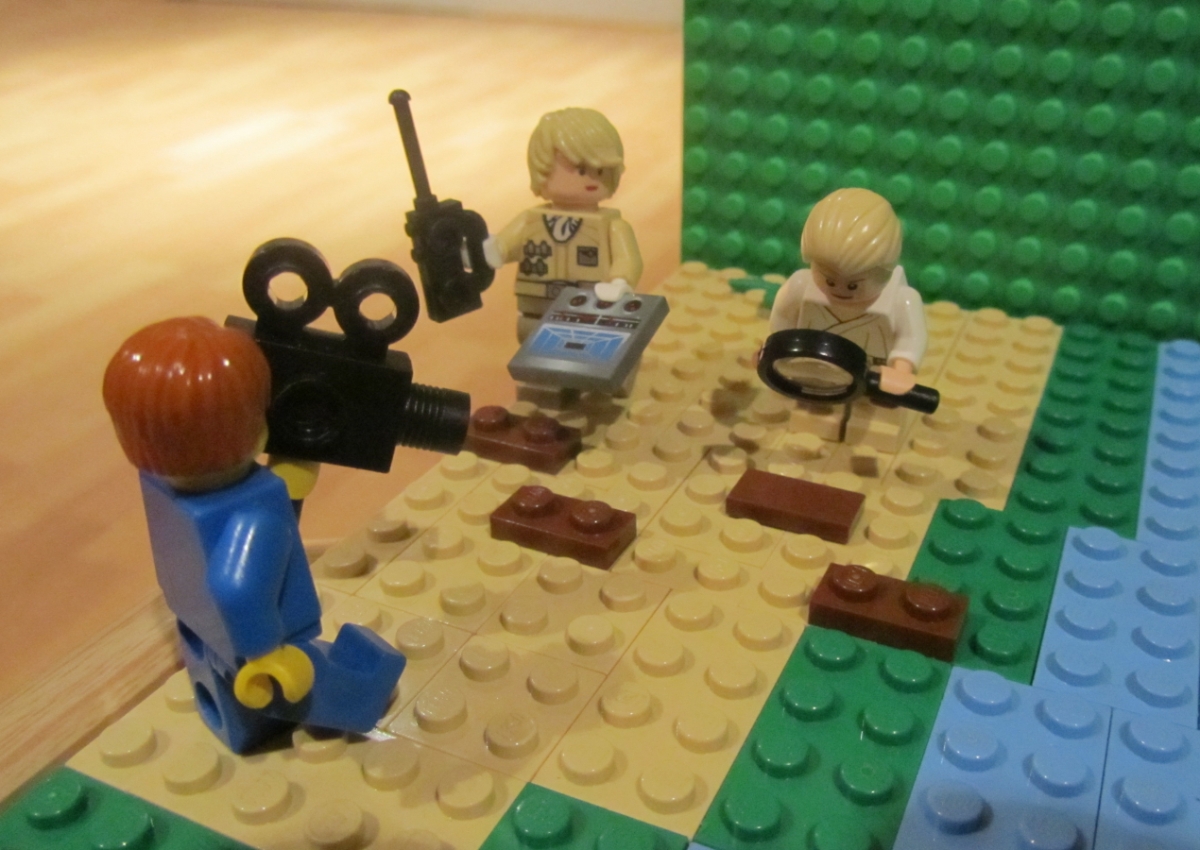
Working with a mish-mash of Lego block sets, my kids and I recreated the Animal Planet TV show “Finding Bigfoot” in a diorama.
My previous Lego artwork includes a mashup of sci-fi epic “Star Wars” and reality TV show “Storage Wars.” (See photo here.)
For my Lego “Finding Bigfoot” diorama, I used Chewbacca from “Star Wars” as my sasquatch stand-in. (Chewie has played this role in at least one other Lego bigfoot recreation before mine. See Cryptomundo and The Brothers Brick.)
I used a beardless Hagrid from the “Harry Potter” series to depict jumbo-sized bigfoot investigator James “Bobo” Fay.
In the first photo, biologist Ranae Holland and bigfoot investigator Cliff Barackman check out squatch tracks near a stream, while a cameraman records their findings.
In the next photo, Bigfoot Field Researchers Organization founder Matt Moneymaker chases a squatch into the woods.
And finally Bobo makes wood knocks using two clubs, oblivious to what’s going on behind him.
Monday, March 5, 2012
Wednesday, February 29, 2012
‘Finding Bigfoot’ – a guilty pleasure TV show
Animal Planet’s “Finding Bigfoot” is a hoot. The reality TV show about a team of researchers trying to find evidence of the existence of sasquatches is sublimely ridiculous. It’s the most entertaining comedy on TV.
The show, now in its second season, features three true believers and one skeptic who go into the woods and howl like big apes and knock wood to try to attract bigfoots. Each episode of “Finding Bigfoot” ends with the group not finding any squatches, but convinced that the “evidence” they discovered proves that bigfoots are there.
The group is led by Matt Moneymaker, president of the Bigfoot Field Researchers Organization. Matt has a crazy look about him and is quick to leap to conclusions that something is bigfoot-related, even when the evidence is flimsy.
The two other believers are James “Bobo” Fay, a giant of a man who could pass for a bigfoot if he were a little more hairy, and Cliff Barackman, who is considered the most level-headed of the three.
Tagging along as the voice of reason is biologist Ranae Holland, who is like Scully from “The X-Files.”
In each episode of the show, the “Finding Bigfoot” team meets locals who have witnessed squatches firsthand. They hold town meetings to hear stories of encounters, then go out on nighttime expeditions in the woods to look for bigfoots.
I’ve been using the show to try to teach my kids about critical thinking. Just because adults believe something doesn’t mean it’s true, I’ll say. Where’s the evidence? Why no remains of dead bigfoot or even some shed hair or squatch feces? How can such a large animal remain so elusive? How can these creatures sustain a breeding population? The true believers are quick with theories, but they’re far-fetched.
My son, 8, calls the show “Not Finding Bigfoot.” And my daughter, 6, thinks Animal Planet’s next show should be “Finding Unicorns.”
My wife thinks Animal Planet, owned by Discovery Communications, is becoming the “redneck channel.” With shows like “Finding Bigfoot,” “Hillbilly Handfishin’,” “Gator Boys,” “American Stuffers” and “Rattlesnake Republic,” she’s got a point.
Photos: The cast of Animal Planet’s “Finding Bigfoot” and the show’s title card.
The show, now in its second season, features three true believers and one skeptic who go into the woods and howl like big apes and knock wood to try to attract bigfoots. Each episode of “Finding Bigfoot” ends with the group not finding any squatches, but convinced that the “evidence” they discovered proves that bigfoots are there.
The group is led by Matt Moneymaker, president of the Bigfoot Field Researchers Organization. Matt has a crazy look about him and is quick to leap to conclusions that something is bigfoot-related, even when the evidence is flimsy.
The two other believers are James “Bobo” Fay, a giant of a man who could pass for a bigfoot if he were a little more hairy, and Cliff Barackman, who is considered the most level-headed of the three.
Tagging along as the voice of reason is biologist Ranae Holland, who is like Scully from “The X-Files.”
In each episode of the show, the “Finding Bigfoot” team meets locals who have witnessed squatches firsthand. They hold town meetings to hear stories of encounters, then go out on nighttime expeditions in the woods to look for bigfoots.
I’ve been using the show to try to teach my kids about critical thinking. Just because adults believe something doesn’t mean it’s true, I’ll say. Where’s the evidence? Why no remains of dead bigfoot or even some shed hair or squatch feces? How can such a large animal remain so elusive? How can these creatures sustain a breeding population? The true believers are quick with theories, but they’re far-fetched.
My son, 8, calls the show “Not Finding Bigfoot.” And my daughter, 6, thinks Animal Planet’s next show should be “Finding Unicorns.”
My wife thinks Animal Planet, owned by Discovery Communications, is becoming the “redneck channel.” With shows like “Finding Bigfoot,” “Hillbilly Handfishin’,” “Gator Boys,” “American Stuffers” and “Rattlesnake Republic,” she’s got a point.
Photos: The cast of Animal Planet’s “Finding Bigfoot” and the show’s title card.
Monday, February 27, 2012
Cee Lo Green’s cat, star of ‘The Voice’
For my money, the star of NBC’s “The Voice” is Cee Lo Green’s cat Purrfect. Whenever Purrfect is on camera, the fluffy white Persian steals the scene.
Green looks like James Bond villain Ernst Stavro Blofeld when he’s petting the cat while talking to the camera.
I’m a cat lover with a long-haired Himalayan of my own. So I can appreciate the beauty and grace of Purrfect.
I’m not alone in thinking Purrfect is a star. She even has her own Twitter and Facebook pages.
Update (March 6): The March 9 issue of Entertainment Weekly reports that Cee Lo’s cat is just a rental and not his own. Purrfect is owned by Benay’s Bird & Animal Rentals. “I told (the producers) I wanted a nod to iconic villains like Dr. Evil,” Green told EW.
Other articles on Purrfect:
Pawing his way to the top: Cee Lo Green’s cat Purrfect is furry popular after appearing on The Voice (The Daily Mail; Feb. 15, 2012)
Cee Lo Green With Cat animated GIF (Reviler; Feb. 17, 2012)
Access Q&A: Cee Lo Green’s ‘The Voice’ Cat Purrfect Speaks! (Access Hollywood; Feb. 27, 2012)
Sunday, February 26, 2012
Book cover fail
I recently spotted this book called “12 Steps to a New Career” and wondered who could have approved the cover art.
Obviously an art director sorted through stock photos looking for something artistic that represented the metaphor of taking a “step.” Instead, what the publisher chose was a picture of a guy taking a death-defying leap over a deep rock chasm.
The subject of the photo clearly had to make a running start and it doesn’t look like he’s going to make it.
If that’s the first of 12 “steps” to a new career, then count me out.
Obviously an art director sorted through stock photos looking for something artistic that represented the metaphor of taking a “step.” Instead, what the publisher chose was a picture of a guy taking a death-defying leap over a deep rock chasm.
The subject of the photo clearly had to make a running start and it doesn’t look like he’s going to make it.
If that’s the first of 12 “steps” to a new career, then count me out.
Wednesday, February 22, 2012
Why you should care about the public domain
The public domain is a fairly obscure topic, but one in which Americans should take an interest.
It involves who owns and controls ideas and our shared culture.
Patents and copyrights used to be on equal legal footing. Patents protect inventions. Copyrights protect works of art. The government gives each a limited period of exclusivity, during which time it enforces a legal monopoly for the patent and copyright holders.
When the protection period is over, others are free to improve upon those ideas.
With patents, this is well understood. When patents expire on drugs, computer technology and other things, creativity flourishes and the public benefits.
The same holds for creative works. Artists are able to freely explore the concepts in off-copyright works without fear of reprisals from the original rights-holders. It provides opportunities for young filmmakers, theater groups, cartoonists and others to present familiar stories in fresh ways.
Human culture has been built over time by the works of others. That includes all forms of ideas – scientific, creative, political, legal, etc.
The website Everything Is A Remix has an ongoing project to show how copyrighted stories like “Star Wars,” “The Matrix” and “Raiders of the Lost Ark” are not as original as they seem. Movies, music and other modern creative works build on the ideas of others and borrow elements from them.
Everything Is A Remix is the work of New York-based filmmaker Kirby Ferguson. He’s done a terrific job explaining a complex issue.
The website TechDirt also is a good resource for pointing out problems and issues with modern copyright laws.
While term lengths for patent protection have remained stable. Term lengths for copyright protection regularly get extended by acts of Congress.
If you want a clear example of how lobbying interests control Washington look no further than the entertainment industry’s sway over Congress on copyright term extensions.
Originally, copyrights in the U.S. lasted 14 years, with the right to renew for another 14-year term if the copyright holder was still alive.
Now, for works created after Jan. 1, 1978, U.S. copyright protection lasts for the life of the author plus an additional 70 years. For works created for hire (such as for Disney), the copyright endures for a term of 95 years from the year of its first publication.
When Walt Disney’s first Mickey Mouse cartoon “Steamboat Willie” (1928) approaches the end of its copyright protection, you can count on Disney to push for another extension.
Public domain works today are those published before 1923. Everything after that is locked down by copyright extensions.
Here is a recap of my recent posts on copyright and the public domain:
Hollywood hot for fairytales (Jan. 29, 2012)
Pop culture artists love to reimagine fairytale characters (Feb. 1, 2012)
Science fiction, horror and fantasy stories in the public domain (Feb. 6, 2012)
More public-domain adaptations: Peter Pan, Mysterious Island and Dr. Jekyll & Mr. Hyde (Feb. 7, 2012)
Hollywood loves free stories like Robin Hood, Tarzan and Pinocchio (Feb. 9, 2012)
Hollywood’s cheat sheet: Public domain works (Feb. 12, 2012)
Public domain tapped out? Try making movies based on historical figures (Feb. 14, 2012)
The dark side of fairy tales (Feb. 15, 2012)
Get ready for 9 new ‘Frankenstein’ movies and TV shows (Feb. 19, 2012)
How Hollywood remakes public domain stories and characters (Feb. 20, 2012)
Photo: Publicity art for actor-director Ralph Fiennes’ “Coriolanus,” based on a play by William Shakespeare.
It involves who owns and controls ideas and our shared culture.
Patents and copyrights used to be on equal legal footing. Patents protect inventions. Copyrights protect works of art. The government gives each a limited period of exclusivity, during which time it enforces a legal monopoly for the patent and copyright holders.
When the protection period is over, others are free to improve upon those ideas.
With patents, this is well understood. When patents expire on drugs, computer technology and other things, creativity flourishes and the public benefits.
The same holds for creative works. Artists are able to freely explore the concepts in off-copyright works without fear of reprisals from the original rights-holders. It provides opportunities for young filmmakers, theater groups, cartoonists and others to present familiar stories in fresh ways.
Human culture has been built over time by the works of others. That includes all forms of ideas – scientific, creative, political, legal, etc.
The website Everything Is A Remix has an ongoing project to show how copyrighted stories like “Star Wars,” “The Matrix” and “Raiders of the Lost Ark” are not as original as they seem. Movies, music and other modern creative works build on the ideas of others and borrow elements from them.
Everything Is A Remix is the work of New York-based filmmaker Kirby Ferguson. He’s done a terrific job explaining a complex issue.
The website TechDirt also is a good resource for pointing out problems and issues with modern copyright laws.
While term lengths for patent protection have remained stable. Term lengths for copyright protection regularly get extended by acts of Congress.
If you want a clear example of how lobbying interests control Washington look no further than the entertainment industry’s sway over Congress on copyright term extensions.
Originally, copyrights in the U.S. lasted 14 years, with the right to renew for another 14-year term if the copyright holder was still alive.
Now, for works created after Jan. 1, 1978, U.S. copyright protection lasts for the life of the author plus an additional 70 years. For works created for hire (such as for Disney), the copyright endures for a term of 95 years from the year of its first publication.
When Walt Disney’s first Mickey Mouse cartoon “Steamboat Willie” (1928) approaches the end of its copyright protection, you can count on Disney to push for another extension.
Public domain works today are those published before 1923. Everything after that is locked down by copyright extensions.
Here is a recap of my recent posts on copyright and the public domain:
Hollywood hot for fairytales (Jan. 29, 2012)
Pop culture artists love to reimagine fairytale characters (Feb. 1, 2012)
Science fiction, horror and fantasy stories in the public domain (Feb. 6, 2012)
More public-domain adaptations: Peter Pan, Mysterious Island and Dr. Jekyll & Mr. Hyde (Feb. 7, 2012)
Hollywood loves free stories like Robin Hood, Tarzan and Pinocchio (Feb. 9, 2012)
Hollywood’s cheat sheet: Public domain works (Feb. 12, 2012)
Public domain tapped out? Try making movies based on historical figures (Feb. 14, 2012)
The dark side of fairy tales (Feb. 15, 2012)
Get ready for 9 new ‘Frankenstein’ movies and TV shows (Feb. 19, 2012)
How Hollywood remakes public domain stories and characters (Feb. 20, 2012)
Photo: Publicity art for actor-director Ralph Fiennes’ “Coriolanus,” based on a play by William Shakespeare.
Monday, February 20, 2012
How Hollywood remakes public domain stories and characters
Filmmakers are free to put interesting spins on classic works because they are free to use and they don’t have to get permission from authors to adapt them, sometimes radically.
Here are some of the approaches filmmakers take to freshen up public domain works:
- Make the material darker for adult audiences
- Make the story more suitable for kids and families
- Change the sex of the lead character or characters
- Change the race of the lead character or characters
- Portray a younger version of the main character or characters
- Set the story in the present day
- Set the story in the future
- Change the genre of the story (i.e., make it an action movie, comedy, musical or science-fiction tale)
- Make a sequel to the original story
- Make a prequel to the original story
- Do a mash-up, combining characters and stories from different public domain works
- Tell the story from a different character’s perspective
- Go back to the source material for a more authentic version than people are used to
- Make the film in a different medium such as animation or 3-D
Photos: Publicity photos for “Snow White & the Huntsman,” a darker, action-filled take on the original fairytale.
Sunday, February 19, 2012
Get ready for 9 new ‘Frankenstein’ movies and TV shows
Among the many public domain works of literature that are being developed into movies and TV shows now, some are more popular than others.
“Frankenstein” tops the list with nine movies or TV series now in development or production. Second place is a tie between “The Wonderful Wizard of Oz” and “Beauty and the Beast,” each with six movies or TV shows in production.
Top 10 most popular public domain works today based on movie and TV show adaptations in the works
1. “Frankenstein” – 8 movies and 1 TV series
2. (tie) “Dracula” – 5 movies and 1 TV series
2. (tie) “The Wonderful Wizard of Oz” – 5 movies and 1 TV mini-series
4. (tie) “Beauty and the Beast” – 2 movies and 2 TV shows
4. (tie) The Bible – 4 movies
6. (tie) “Peter Pan” – 3 movies
6. (tie) “Pinocchio” – 3 movies
6. (tie) Sherlock Holmes – 1 movie and 2 TV shows
6. (tie) “Snow White” – 3 movies
10. (tie) “20,000 Leagues Under the Sea” – 2 movies
10. (tie) “Dr. Jekyll & Mr. Hyde” – 2 TV series
10. (tie) King Arthur and Merlin – 2 movies
10. (tie) Robin Hood – 2 movies
10. (tie) “Sleeping Beauty” – 2 movies
Photo: Title page from Mary Shelley’s “Frankenstein” (1818)
“Frankenstein” tops the list with nine movies or TV series now in development or production. Second place is a tie between “The Wonderful Wizard of Oz” and “Beauty and the Beast,” each with six movies or TV shows in production.
Top 10 most popular public domain works today based on movie and TV show adaptations in the works
1. “Frankenstein” – 8 movies and 1 TV series
2. (tie) “Dracula” – 5 movies and 1 TV series
2. (tie) “The Wonderful Wizard of Oz” – 5 movies and 1 TV mini-series
4. (tie) “Beauty and the Beast” – 2 movies and 2 TV shows
4. (tie) The Bible – 4 movies
6. (tie) “Peter Pan” – 3 movies
6. (tie) “Pinocchio” – 3 movies
6. (tie) Sherlock Holmes – 1 movie and 2 TV shows
6. (tie) “Snow White” – 3 movies
10. (tie) “20,000 Leagues Under the Sea” – 2 movies
10. (tie) “Dr. Jekyll & Mr. Hyde” – 2 TV series
10. (tie) King Arthur and Merlin – 2 movies
10. (tie) Robin Hood – 2 movies
10. (tie) “Sleeping Beauty” – 2 movies
Photo: Title page from Mary Shelley’s “Frankenstein” (1818)
Subscribe to:
Posts (Atom)


